




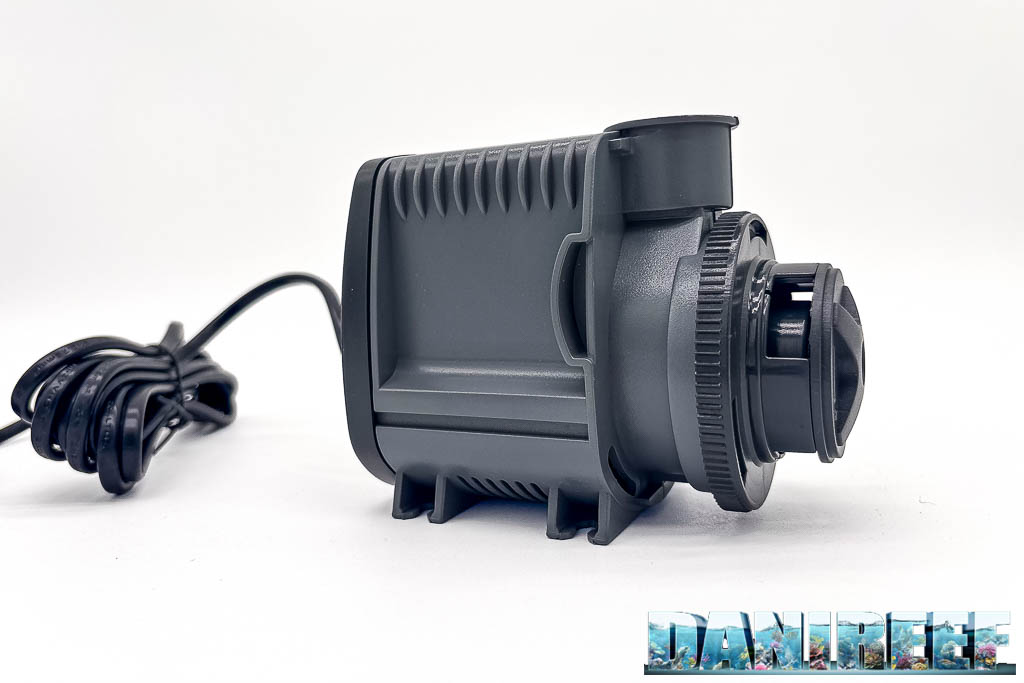
The Sicce Syncra Silent 2.0 is back in the DaniReef LAB, fourteen years after our first test. It was 2012 when we measured the flow, head and power consumption of this pump, first with a home-made rig and then with the instruments of the Sicce laboratory. Today we can repeat those measurements with our updated equipment.

After revisiting the Sicce Syncra Silent 1.5 in our recent review, we continue our journey through Sicce centrifugal pumps with the Syncra Silent 2.0. Given its rated flow and head, this pump can also be used as a return pump in aquariums where the height difference is not too demanding.
Choosing a return pump, however, should never start simply from the volume of the aquarium. As we explained in our in-depth article How to choose the right return pump for a marine aquarium, its main job is to ensure proper water exchange between the display tank and the sump, taking into account above all the amount of water actually processed by the protein skimmer.
A pump that is too small risks limiting the skimmer’s work, while an oversized pump can needlessly increase power consumption without bringing any real benefit to filtration. This is why knowing the actual flow and head, and not just the rated figures, is essential to size our system correctly.
The Syncra Silent 2.0 is an AC centrifugal pump with no electronic controller. Flow is adjusted mechanically, while the motor speed cannot be changed through programmes or digital settings. It is a relatively simple solution, designed to run continuously.
Sicce Syncra Silent 2.0 technical specifications
| Model | Sicce Syncra Silent 2.0 |
| Type | AC centrifugal pump, fixed flow with mechanical adjustment |
| Rated maximum flow | 2,150 l/h |
| Rated maximum head | 2.0 m |
| Rated power consumption | 32 W |
| Dimensions reported in the 2012 test | 123 × 85 × 105 mm |
| Use | Submersible or inline, according to the manufacturer’s instructions |
| Adjustment | Mechanical |
The rated reference value, according to the conventional index we use in the DaniReef LAB, is 2,150 l·m/h. We obtain it by multiplying the rated maximum flow by the rated maximum head and dividing the result by two.
Remember that this is a useful index for comparing pumps of similar size; it is not a measure of hydraulic efficiency, nor of the actual area under the pump’s performance curve.
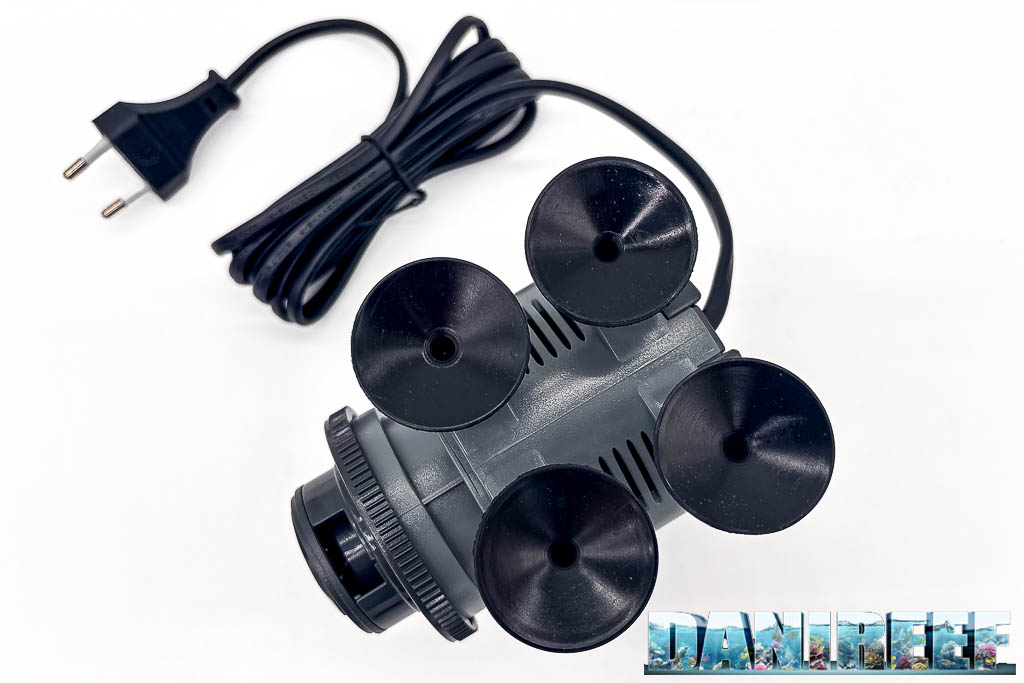
Construction and adjustment
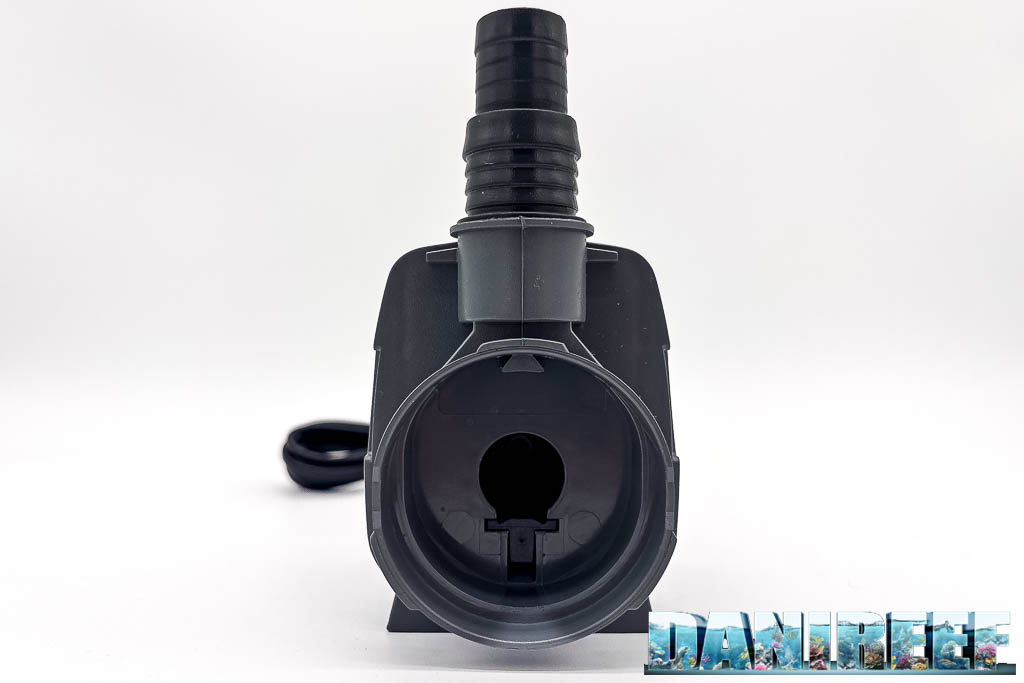
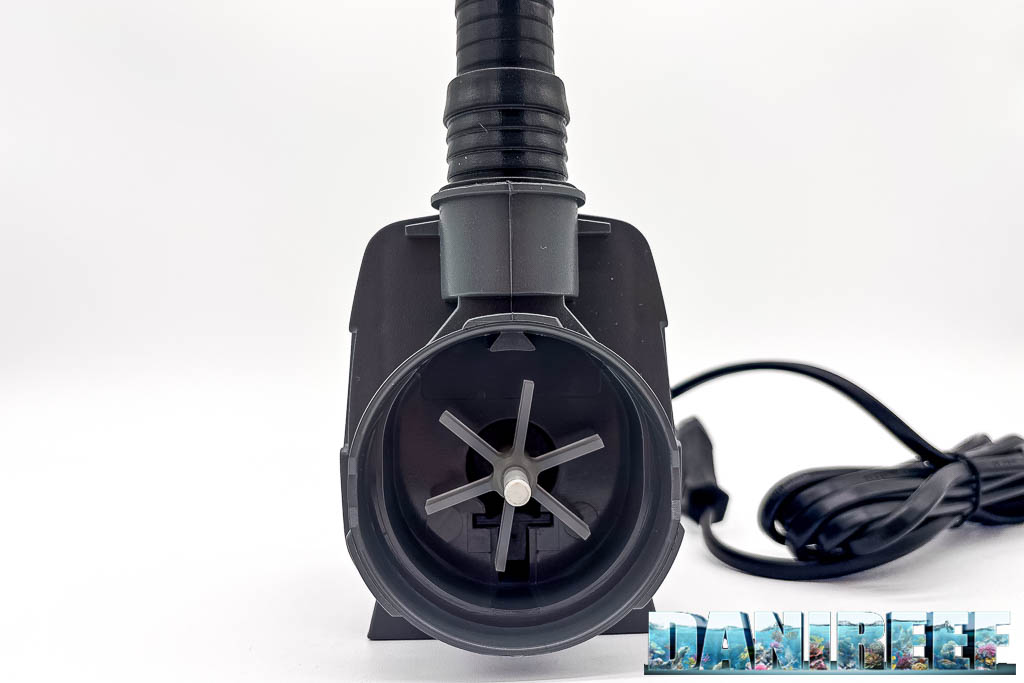
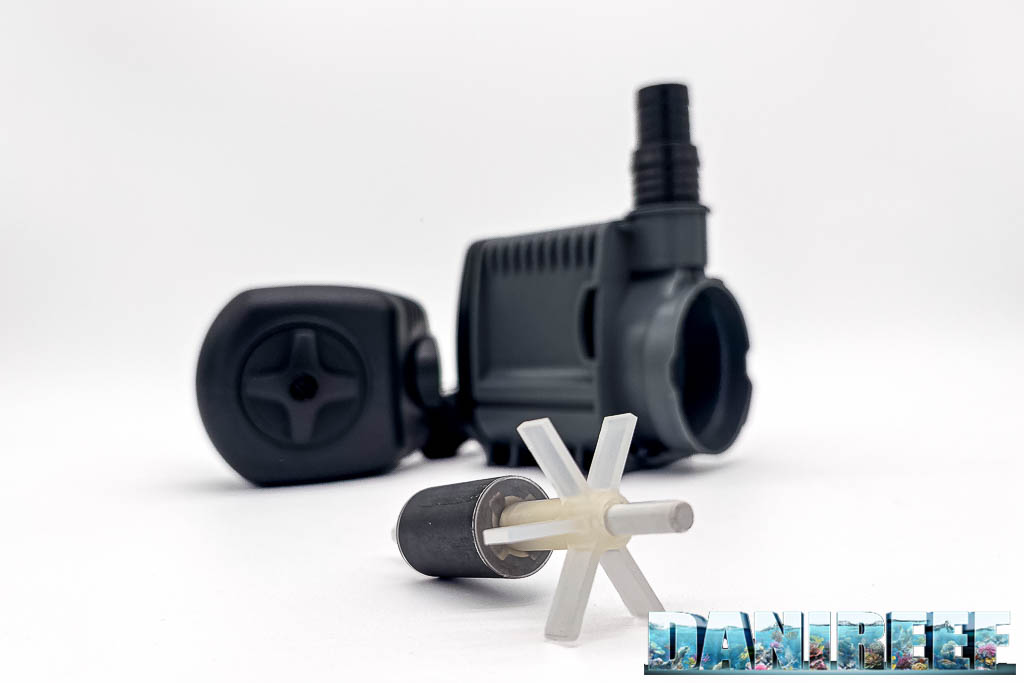
The Sicce Syncra Silent 2.0 belongs to the same family as the 1.5 we tested a few weeks ago. The design philosophy is that of traditional centrifugal pumps: a relatively compact body, an impeller driven by an AC motor and mechanical flow adjustment.
For our measurements we used the fully open setting, so as to check the performance achievable under test-bench conditions.
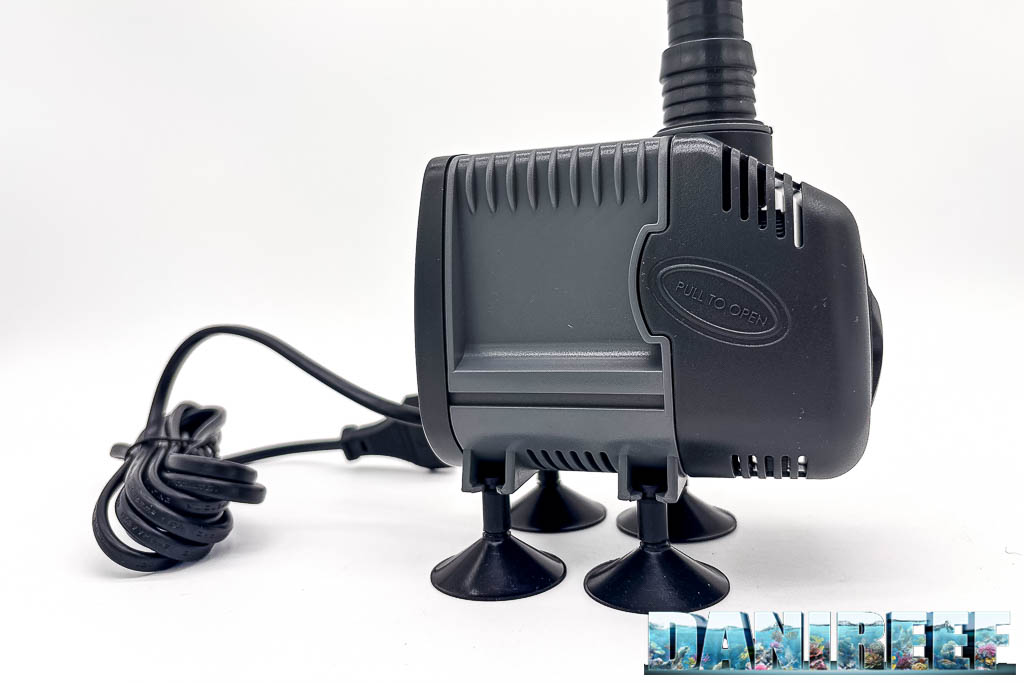
As we often point out, choosing a pump must always go hand in hand with correctly sizing the plumbing. A pipe that is too narrow, lots of bends or restrictive fittings can significantly reduce the flow available in the aquarium, even when the pump has a high rated flow.
Pipe diameter in particular is an often underestimated parameter. For the same flow, reducing the cross-section means increasing water velocity and, as a consequence, friction losses. This may force us to use a more powerful pump to obtain the same result.
We discussed this in depth in the article How to save electric power in a marine aquarium: the return pipe, where we explained why choosing the right diameter can be just as important as choosing a good pump.
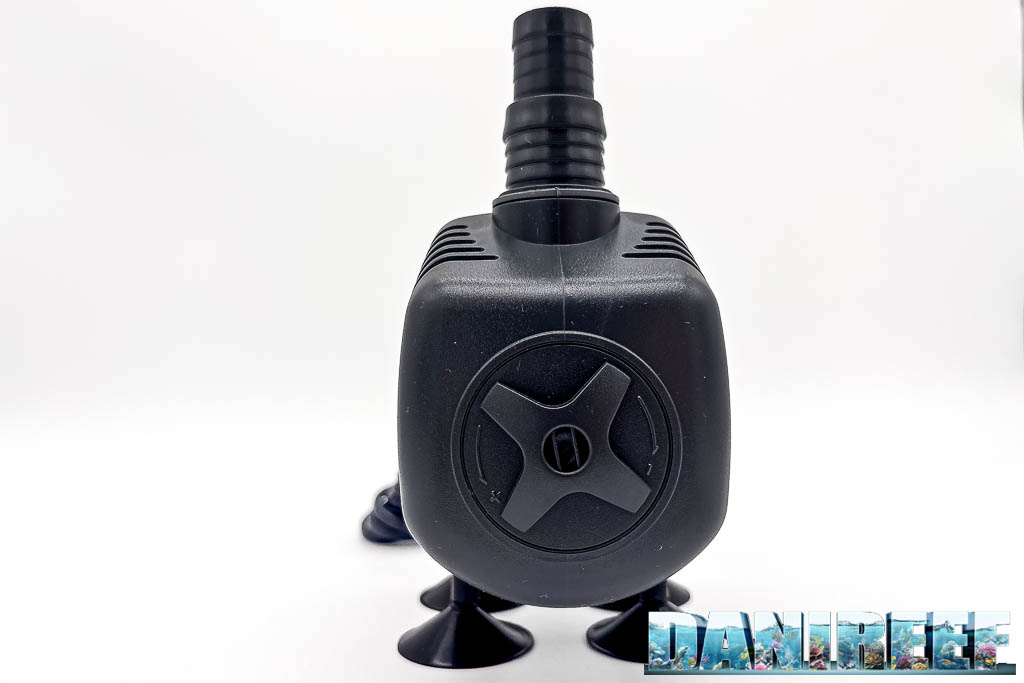
The tests in the DaniReef LAB
To measure flow we use the DigiFlow 6710M, for power consumption the RCE PM600, and for head an electronic pressure transducer connected to a digital indicator.
The pressure transducer is one of the most important new features of our current test method. It allows us to measure the pressure generated by the pump with the outlet closed downstream of the sensor, without having to use a long vertical pipe.
We chose an instrument with a measuring range wide enough to be used with much more powerful pumps too. This, however, calls for an important caveat: when we measure relatively low pressures, such as those of the Syncra Silent 2.0, the instrument’s actual resolution and accuracy may affect the comparison.
Methodological note: for head we continue to prudently adopt an indicative margin of ±10%. This is not a certified uncertainty or a metrological calibration of the instrument, but an interpretative precaution that stops us from attaching too much meaning to differences of a few centimetres. The result also depends on the position of the sensor relative to the water level and on the configuration of the test bench.
Head test
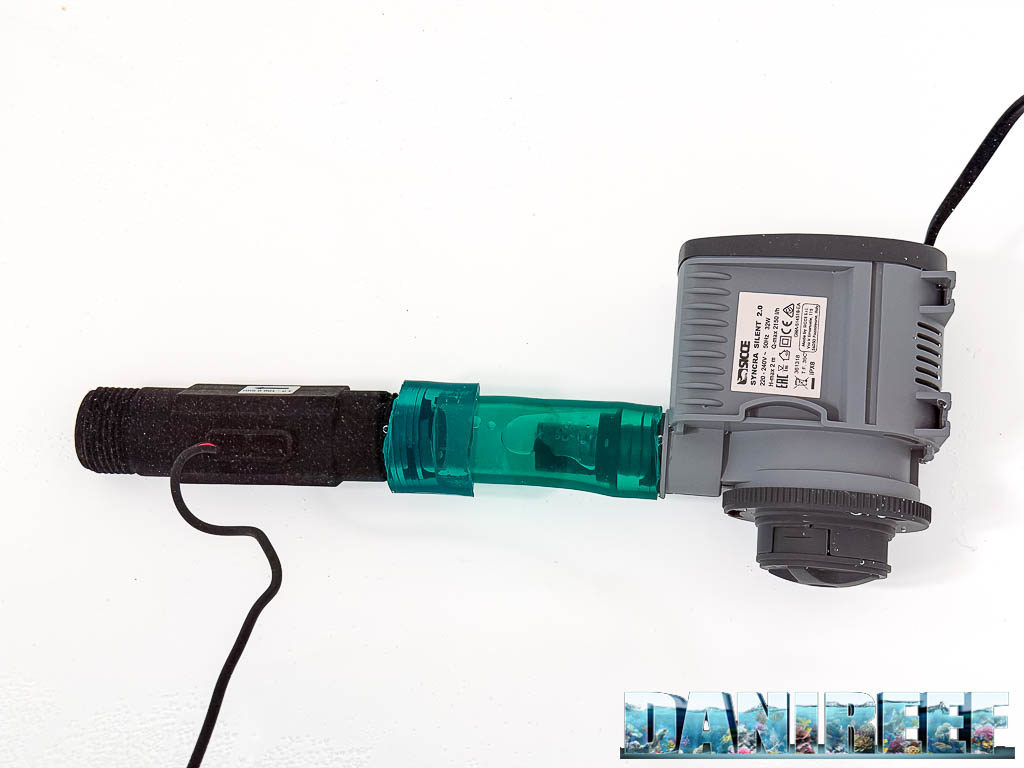
Let’s start with maximum head, that is, the pump’s ability to generate pressure to overcome a height difference. To measure it we completely closed the outlet downstream of the transducer, bringing the pump to zero-flow conditions.
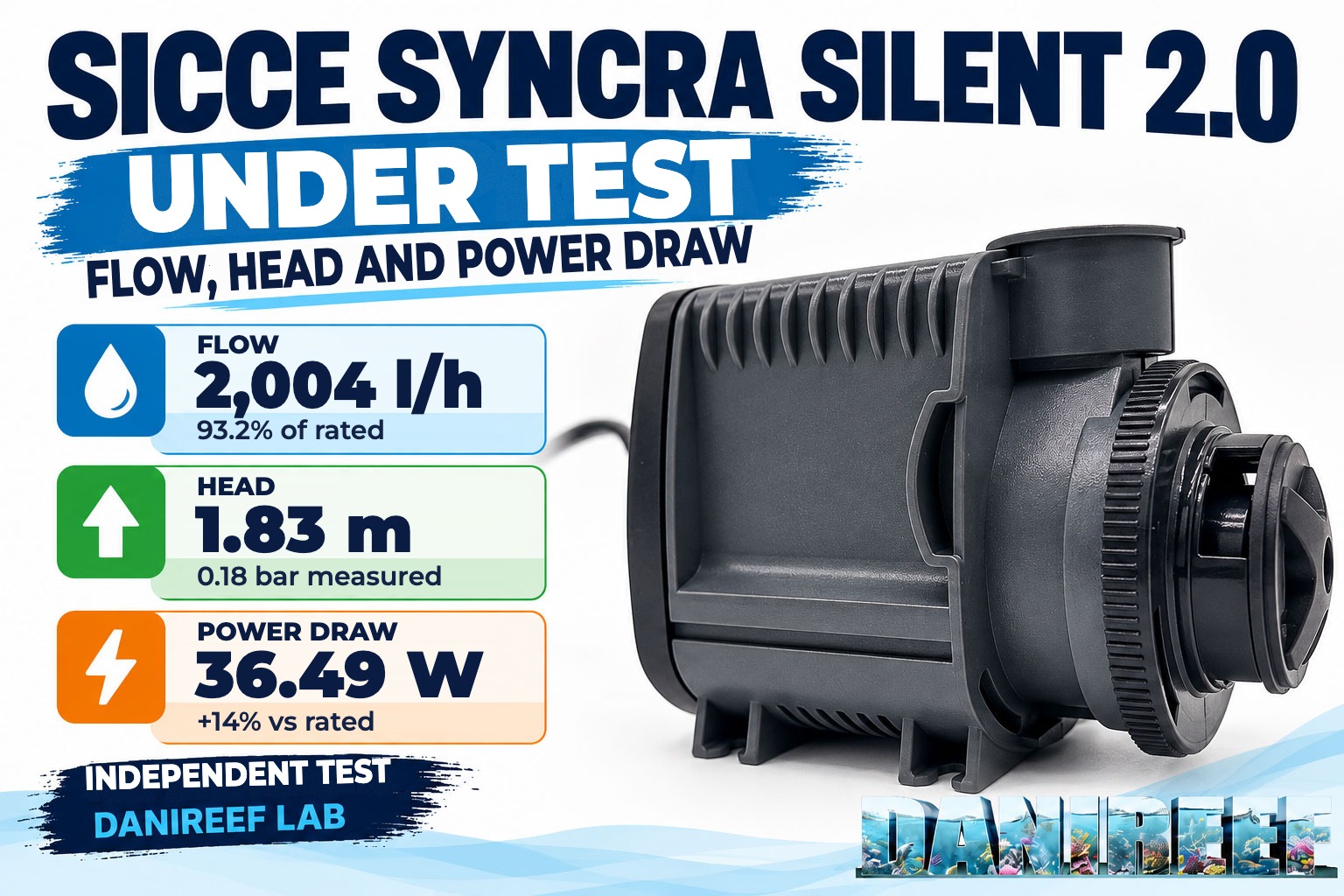
Our instrument read 0.18 bar. Converting this value into metres of water column, we get an equivalent head of about 1.83 metres.
| Parameter | Value |
| Rated head | 200 cm |
| Pressure measured in 2026 | 0.18 bar |
| Equivalent water column | approx. 183 cm |
| Indicative deviation from rated | −8.2% |
| Head measured in 2012, static method | 202 cm |
| Head measured in 2012, Sicce laboratory | 198 cm |
The result is slightly lower than the 2 metres rated by Sicce and the values we obtained in 2012. Back then we measured 202 cm with the water-column method and 198 cm in the Sicce laboratory. Today we stop at about 183 cm.
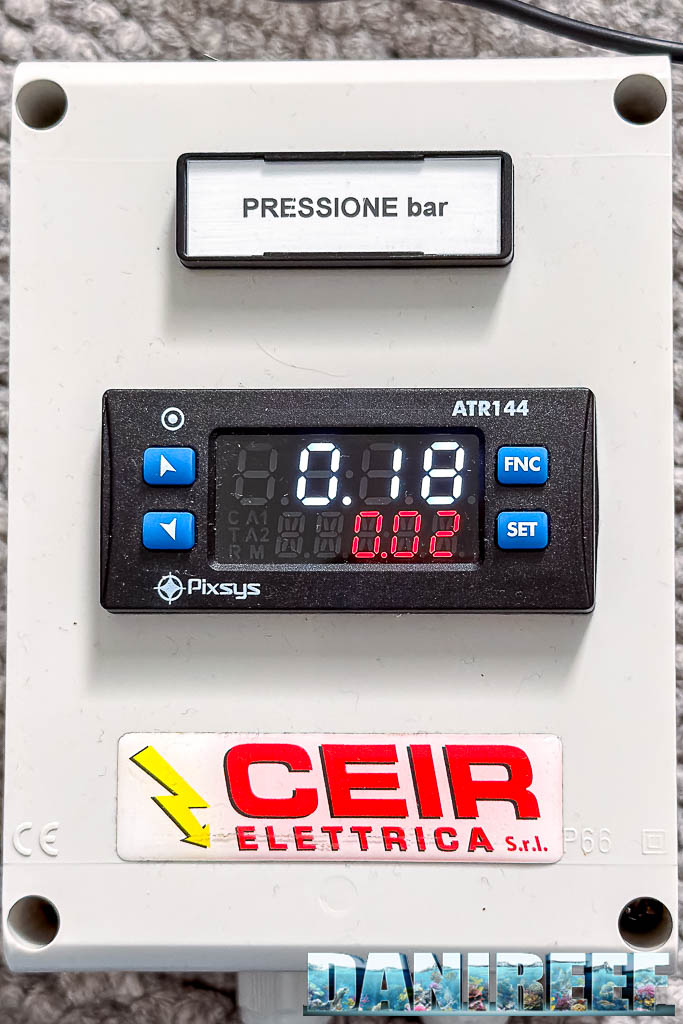
The difference from the rated value is around 8%, so within the prudential margin we decided to use when interpreting the readings of the new transducer. We therefore cannot conclude that the current pump has a genuinely lower head than in 2012: the measuring method has changed and the deviations observed are relatively small.
What does a maximum head of 1.83 metres mean?
It is important to remember that maximum head does not represent the height at which the pump can still deliver a meaningful flow. On the contrary, as you approach maximum head, flow tends towards zero.
This means we cannot install a Syncra Silent 2.0 with a 180 cm height difference and expect to get the 2,004 l/h we measured on the test bench. At that height the flow would be zero.
To better understand this relationship, see our article Return pumps: calculating the flow, which helps estimate the actual flow starting from the characteristics of the pump and of your own system.
Of course, the calculation gives an estimate, not a direct measurement: the pump’s real performance curve, pipe diameter, bends and the conditions of the system can change the result, even significantly.
Flow test
Flow is probably the most interesting figure in this new test. With our DigiFlow 6710M we measured 2,004 litres per hour, against the 2,150 l/h rated by the manufacturer.
This means the Syncra Silent 2.0 reached 93.2% of its rated flow, a deviation of just 6.8%.
| Parameter | Value |
| Rated flow | 2,150 l/h |
| Flow measured in 2026 | 2,004 l/h |
| Equivalent flow | 33.4 l/min |
| Percentage of rated | 93.2% |
| Deviation from rated | −6.8% |
| Flow measured in 2012 | 1,944 l/h |
As we have already seen in other reviews, the flow meter and the fittings we use inevitably introduce friction losses. Reaching over 93% of the rated flow under our test-bench conditions is therefore an excellent result.
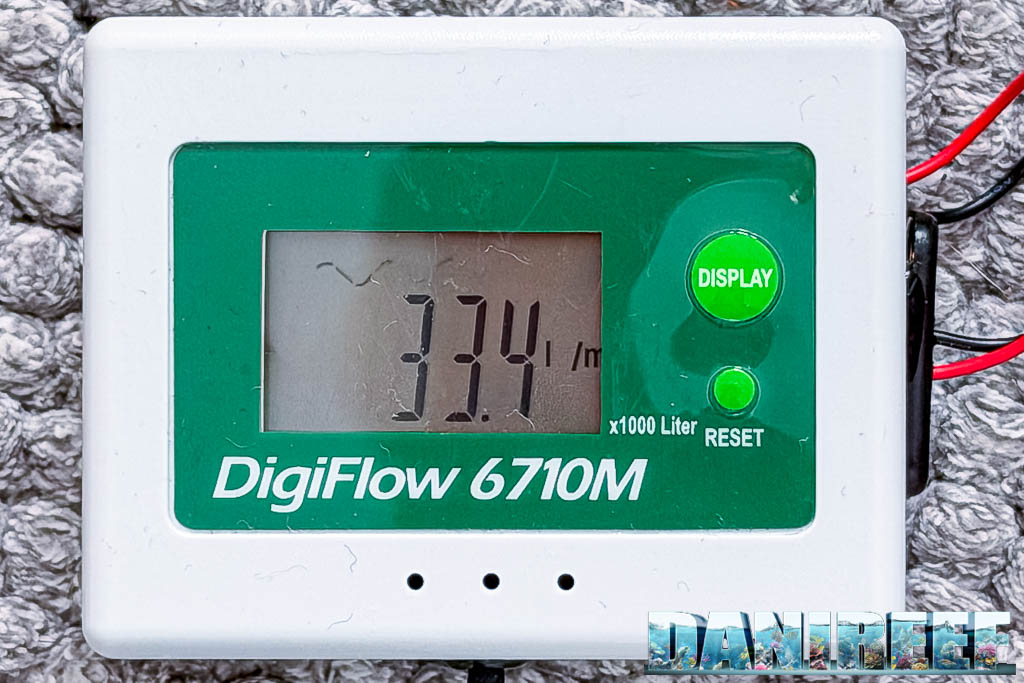
The historical comparison is even more intriguing. In 2012, using the instruments of the Sicce laboratory, we measured 1,944 l/h. Today we got 2,004 l/h: in practice, even after so many years, we can consider the values virtually identical. Well done, Sicce.
How much water will it really deliver to the aquarium?
Remember that the 2,004 l/h is the flow measured on our test bench, not necessarily what we will get once the pump is installed in the sump. When water has to rise from the sump to the display tank, flow drops according to the height difference and the friction losses of the system.
In practice, then, the result could be very different. To get an estimate closer to the conditions of your own aquarium, we recommend reading our guide Return pumps: calculating the flow and working with the pump’s flow and head, the actual height difference and the characteristics of the plumbing.
For this reason, when choosing a return pump we should always start from the flow we actually want to get into the aquarium, not from the maximum value rated by the manufacturer.
Power consumption test
Let’s move on to power consumption, where we find the most noticeable difference from the rated data.
Our RCE PM600 measured a draw of 36.49 watts, against the 32 watts rated by Sicce. The deviation is therefore about +14%.
| Parameter | Value |
| Rated power consumption | 32 W |
| Power consumption measured in 2026 | 36.49 W |
| Deviation from rated | +14.0% |
| Power factor, cosφ | 0.48 |
| Annual energy, continuous operation | 319.7 kWh |
| Annual cost at €0.27/kWh | €86.31 |
| Average monthly cost at €0.27/kWh | €7.19 |
The power consumption of a centrifugal pump can vary according to its operating point, that is, the actual flow and the head it is working against. This is why care is needed when comparing measurements taken under different conditions.
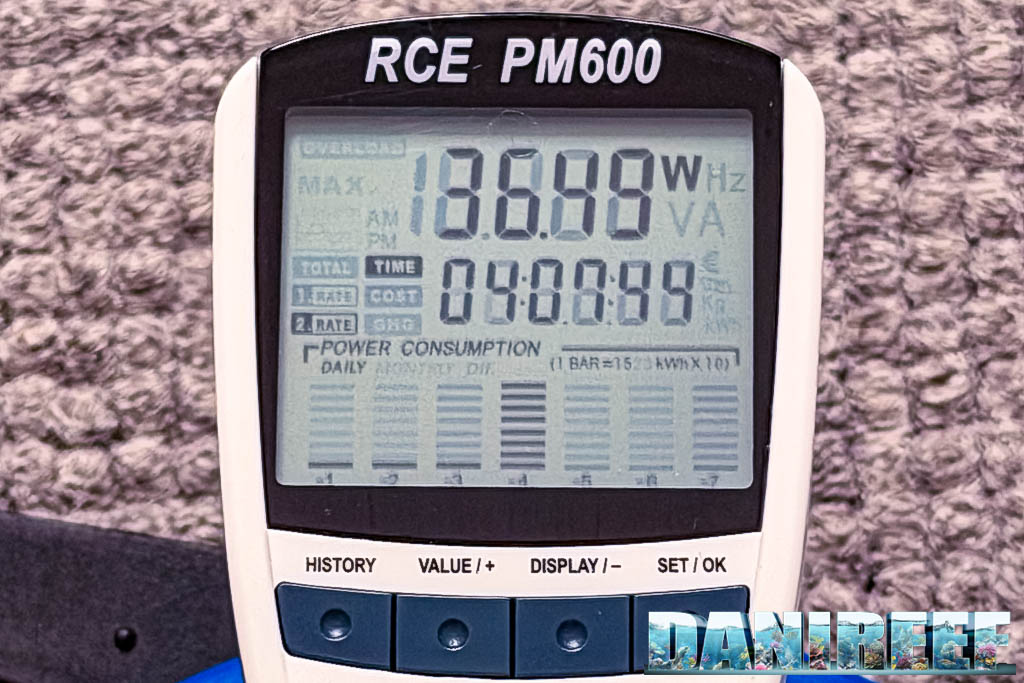
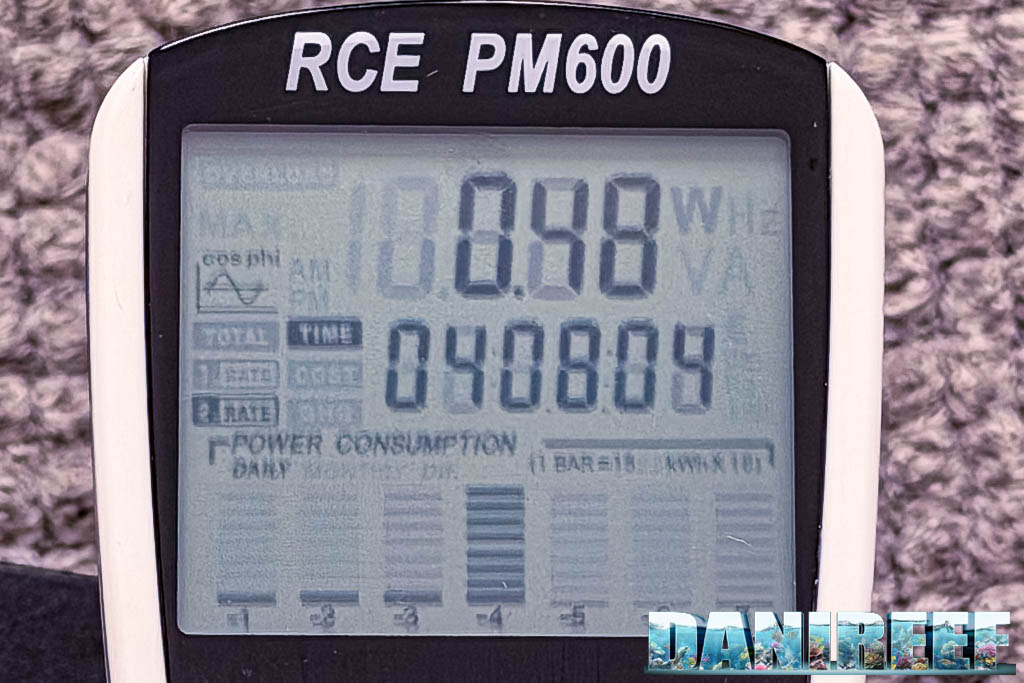
In 2012, in fact, we recorded 31.1 watts in the Sicce laboratory, but at maximum head. We cannot compare that value directly with today’s 36.49 watts as if the two pumps were working at the same point on the curve.
The fact remains that, under the conditions of our 2026 test, the measured consumption is higher than the rated value. For a pump that may stay on 24 hours a day, the difference is worth considering.
How much does it cost to run the Sicce Syncra Silent 2.0?
Assuming continuous operation for 365 days, the 36.49 watts measured correspond to about 319.7 kWh per year.
With a hypothetical tariff of €0.27/kWh, the same one we always use, the annual cost would be about €86, or just over €7 a month. If the pump drew exactly the rated 32 watts, the cost would instead be about €75.69 a year. Under the conditions considered, the difference is therefore about €10.62 a year. All things considered, a negligible figure.
When we assess the power consumption of a return pump, however, we must also consider how much water it actually moves. Two pumps with different consumption can have very different overall efficiency, especially when installed in systems with different plumbing and height differences.
So comparing rated or measured watts is not enough: it is also important to check the flow obtained under real operating conditions. As we discussed in the article How to save electric power in a marine aquarium: the return pipe, a correctly designed hydraulic circuit can help reduce energy waste.
Power factor: cosφ of 0.48
We also measured the power factor, or cosφ, which in our test came out at 0.48.
This parameter expresses the ratio between active power and apparent power at the measuring point. It should not be confused with the pump’s hydraulic efficiency and does not, on its own, tell us how much energy is converted into heat.
The value is close to the 0.504 we recorded in the Sicce laboratory in 2012, although, once again, the operating conditions and the instruments used are not necessarily identical.
Our comments
Overall, the Sicce Syncra Silent 2.0 performed well on our test bench, but with some differences compared with the 1.5 we reviewed recently.
Flow is its strong point. We measured 2,004 l/h, a result very close to the rated 2,150 l/h and even slightly higher than the one we obtained in 2012. Taking into account the inevitable differences between the two measuring systems, we can speak of substantial continuity in performance.
Maximum head came out at about 183 cm, against the rated 200 cm. This difference should be read with caution, because in this case our transducer is working in the lower part of its measuring range. The deviation falls within the prudential margin we decided to adopt.
Power consumption, on the other hand, is the least convincing aspect of the test: 36.49 watts against the rated 32. But we are talking about 5 watts, which I consider negligible.
The Syncra Silent 2.0 remains a relatively simple pump, with no control electronics and with characteristics that can make it an interesting choice for powering small circuits or as a return pump in systems with modest height differences and friction losses.
As always, though, the choice should not be based solely on maximum flow: what really matters is how much water the pump can move at the actual head of our system.
Is the Sicce Syncra Silent 2.0 right for our aquarium?
The answer depends above all on the system we need to feed. Knowing the tank volume is not enough: we have to consider the pump’s actual flow, the height difference to overcome and, in marine aquariums with a sump, the amount of water processed by the protein skimmer.
As we explained in our guide How to choose the right return pump for a marine aquarium, our approach is to size the return according to the skimmer’s real throughput, allowing an additional margin that depends on the sump configuration and on how the treated water is discharged.
In particular, a skimmer with a high outlet that sends water directly into the return pump compartment makes better use of the exchange between display tank and sump. When the skimmer instead discharges into the same compartment it draws from, we must also consider that part of the water may be processed several times.
To learn more about choosing a skimmer and its relationship with the filtration system, we also recommend our article How to choose the skimmer in a marine aquarium?.
The Syncra Silent 2.0 can therefore be a good solution for some systems, but we cannot say in advance which tank volume it is ideal for: the right choice always depends on the overall characteristics of the system.
Comparison with rated data and with 2012
| Parameter | Rated | Measured 2012 | Measured 2026 | Deviation 2026 |
|---|---|---|---|---|
| Flow | 2,150 l/h | 1,944 l/h | 2,004 l/h | −6.8% |
| Head | 200 cm | 198 cm, laboratory | approx. 183 cm | −8.2% indicative |
| Power consumption | 32 W | 31.1 W* | 36.49 W | +14.0% |
| Cosφ | — | 0.504* | 0.48 | — |
This table sums up the pump’s behaviour well. Flow remains close to the rated figure and to our historical results; head is substantially consistent, given the limits of the measurement; power consumption, however, is higher than the nominal value.
It is also interesting to compare the Syncra Silent 2.0 with the Syncra Silent 1.5 we tested a few weeks ago. The 2.0 offers 690 l/h more measured flow, but also requires 13.39 watts more under the respective test conditions.
We cannot turn this comparison into an absolute efficiency ranking, because the two pumps were measured at their respective operating points and not at the same head. The data are nonetheless useful for placing them within the same family.
Conclusions
The measured reference value of the Sicce Syncra Silent 2.0 is about 1,838 l·m/h, against the 2,150 l·m/h derived from the rated values. The difference is about 14.5%, but it is also affected by the head estimate obtained with the electronic transducer. It would make no sense to attribute greater precision to this percentage than our measuring system allows.
What we can say is that the Syncra Silent 2.0 matches its nominal data well as far as flow is concerned, while head is slightly lower, but still consistent within the methodological caveats we have explained.
Power consumption, on the other hand, is higher than stated: the 36.49 watts measured represent an increase of about 14%, which brings the annual energy cost to about €86, assuming continuous operation and a cost of €0.27/kWh.
The comparison with 2012 is perhaps the most interesting aspect of the whole review. Fourteen years later, and with completely different instruments, we find very similar flow values. This does not prove that the product has remained technically identical over time, but it confirms that the fundamental performance measured in the two tests is substantially consistent.
Overall, the Sicce Syncra Silent 2.0 passes our test, with a small reservation about power consumption. It remains a solution worth considering for systems that need a flow of around 2,000 l/h at low head, bearing in mind that the real flow will decrease as the height difference and friction losses increase.
PROS
- Measured flow very close to the rated value.
- Flow performance consistent with that recorded in 2012.
- Simple construction, with no electronic controller.
- Head substantially consistent with the rated figure, within the limits of the measurement.
CONS
- Power consumption 14% higher than rated.
- No electronic power adjustment.
- Limited maximum head for particularly demanding returns.
- Actual flow sensitive to height difference, plumbing and fittings.
Editorial note: all 2026 measurements reported in this article were carried out by the DaniReef LAB. Historical data are taken from our review published in 2012. The results refer to the units and test conditions described and do not represent a certification of the performance of every unit produced.
Recommended reading
To better understand how to choose and size a return pump, we also recommend these in-depth articles published on DaniReef:
- All our return pump articles – The instrumental tests published on DaniReef, with measured flow, head and power consumption.
- How to choose the right return pump for a marine aquarium – Correct sizing in relation to the skimmer and the sump.
- Return pumps: calculating the flow – How to estimate the actual flow in your system.
- How to save electric power in a marine aquarium: the return pipe – Why pipe diameter and characteristics are fundamental.
- How to choose the skimmer in a marine aquarium? – The relationship between filtration, processed flow and tank–sump exchange.
- Sicce Syncra Silent 1.5 Review: Tested Again 14 Years Later – Our test of the smaller model.
- Sicce Syncra Silent pumps 2.0, 2.5 and 3.0: The Total Comparative Test – The original measurements taken in 2012.
Disclaimer: we thank Sicce for their collaboration in the historical 2012 tests. The measurements and assessments in this review were carried out independently by the DaniReef LAB.
Scopri di più da DaniReef - Portale dedicato a Acquario Marino e Dolce
Abbonati per ricevere gli ultimi articoli inviati alla tua e-mail.










, 1.83 m head and 36.49 W, compared with our 2012 test)