
Some products are announced and reach the market just a few months later. And then there are ideas so ambitious that they require years of development, revisions and attempts before becoming something we can actually hold in our hands and install on our aquarium.

MOAI undoubtedly belongs to the second category. When we first talked about it on DaniReef, way back in 2016, it almost seemed like something from the future: a robot capable of moving autonomously across the aquarium glass, cleaning it and, at the same time, showing us what is happening inside the tank through an integrated camera.
Over the years we have followed the project, from the Kickstarter campaign to the first fully functional prototypes, wondering more than once whether MOAI would ever become a product actually available to aquarists. Now the robot has finally arrived at DaniReef, and we can install it on our aquarium, take a close look at it and find out whether this very long wait has been worth it.
MOAI in brief
MOAI does an excellent job of removing the normal algae film from the glass and integrates a surprisingly effective Full HD mobile camera, especially when it comes to correcting blue light. It does not completely eliminate manual cleaning and remains visible on the aquarium glass, but after several weeks of use it has proven reliable, easy to program and particularly useful for checking the aquarium remotely.
Our verdict: an expensive product and certainly not for everyone, but innovative, mature and difficult to give up once it becomes part of your daily aquarium maintenance routine.
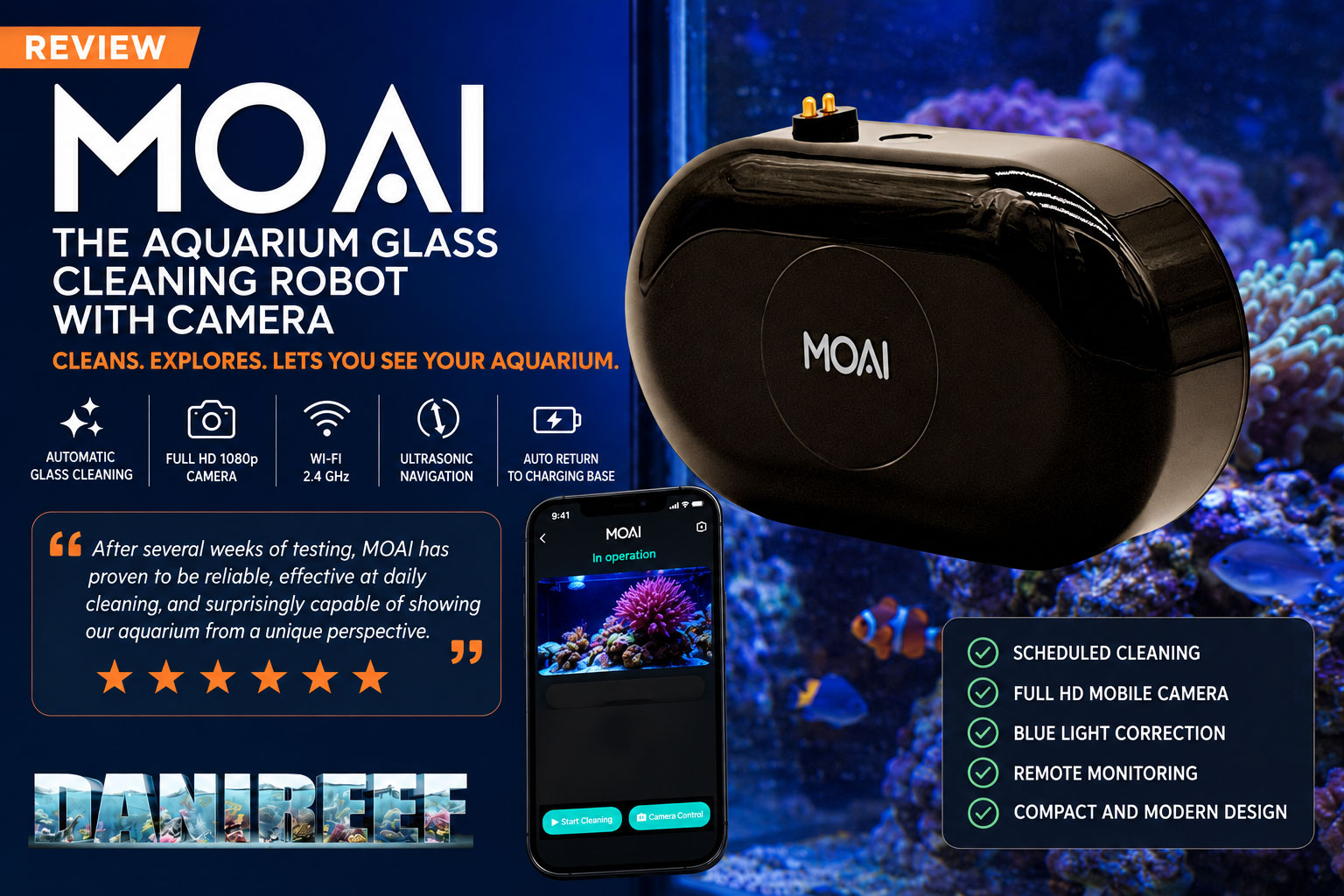
MOAI combines automated glass cleaning with a mobile camera that can be controlled from a smartphone. More than automation alone, it is this combination that sets it apart from a traditional magnetic cleaner and from the other cleaning systems we have seen so far.
MOAI: our video review
In the following video you can see what comes inside the box, the installation of MOAI, the app configuration and the robot operating on our aquarium. We also tested its cleaning performance, connection stability and, above all, the images captured by the integrated camera.
We recommend watching the video, because the robot’s movement across the glass and the perspective offered by the camera are much easier to understand in a video than through pictures and a simple description.
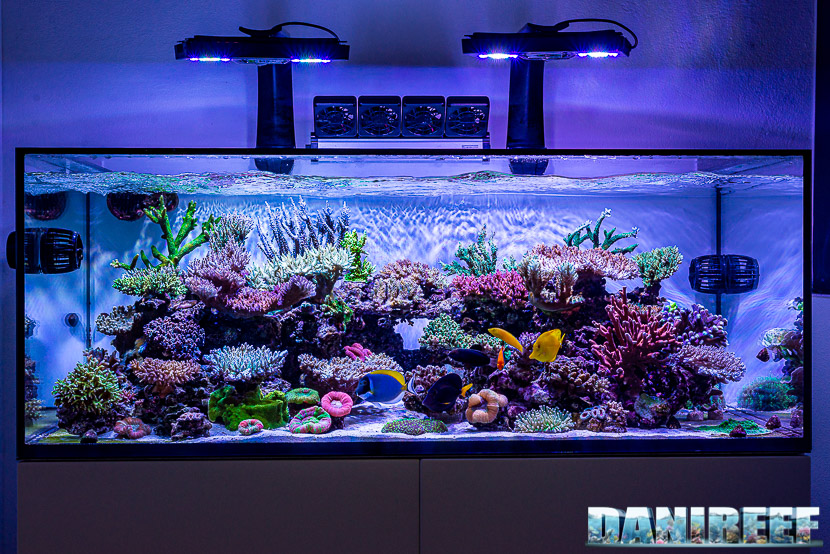
As you may also have noticed in the video, our aquarium is rather empty at the moment. We are waiting for AcquariaItalia 2026, on September 19 and 20, to bring home some new corals and start filling it again as it deserves. For our MOAI test, however, this situation allowed us to see the robot’s movement and the results on the glass even more clearly.
MOAI: a story that started in 2016
DaniReef has been following MOAI since 2016, when we first presented the project. In 2017 we covered its Kickstarter campaign, and in 2020 we once again wondered whether the robot would ever actually reach the market. In 2026, we have finally installed it on our aquarium.
Further reading:
- MOAI, the smart robot that cleans aquarium glass – and much more.
- MOAI Smart Robot lands on Kickstarter.
- MOAI aquarium glass cleaning robot with camera: are we finally there?.
Today, that long history makes our test particularly interesting. We are not reviewing a product that suddenly appeared on the market, but the tangible result of a project that DaniReef has been following closely almost since its very beginning.
What is MOAI?
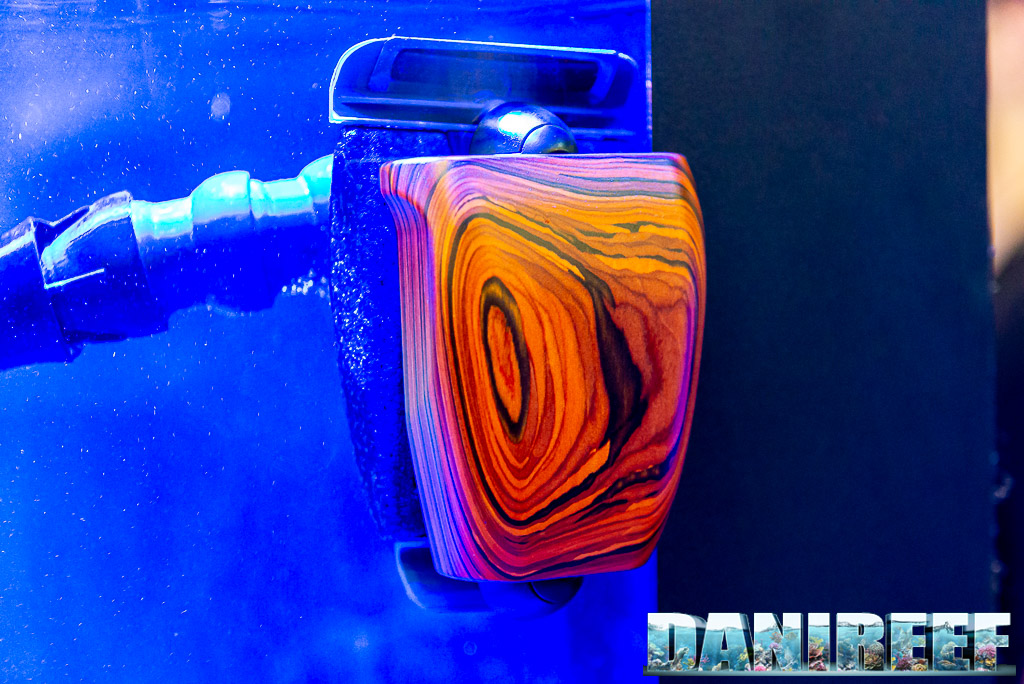
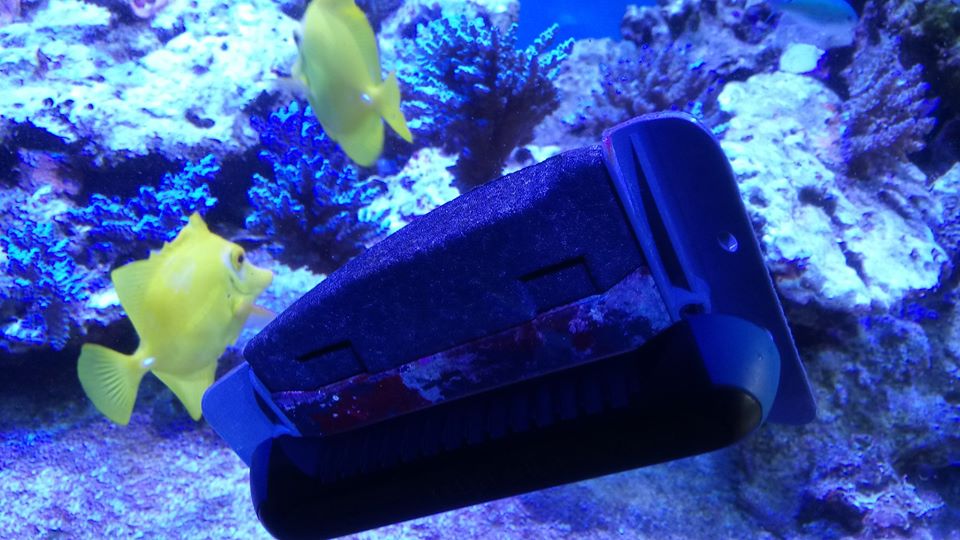
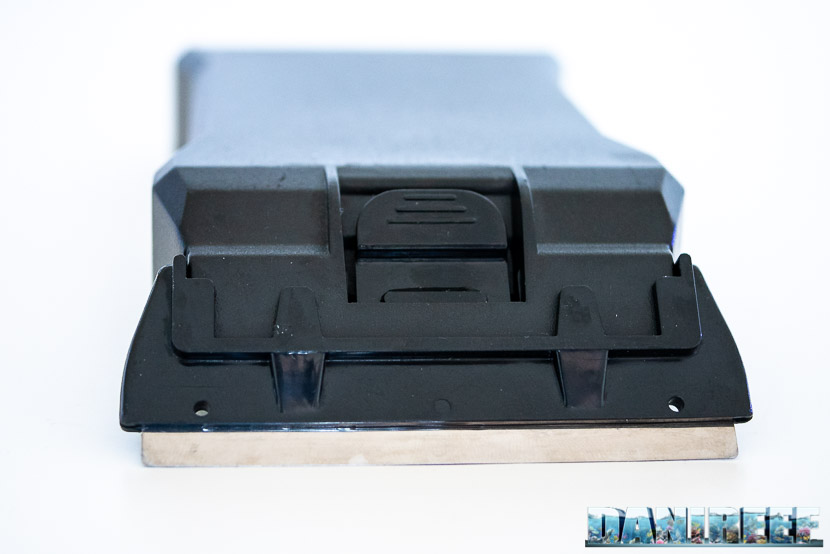
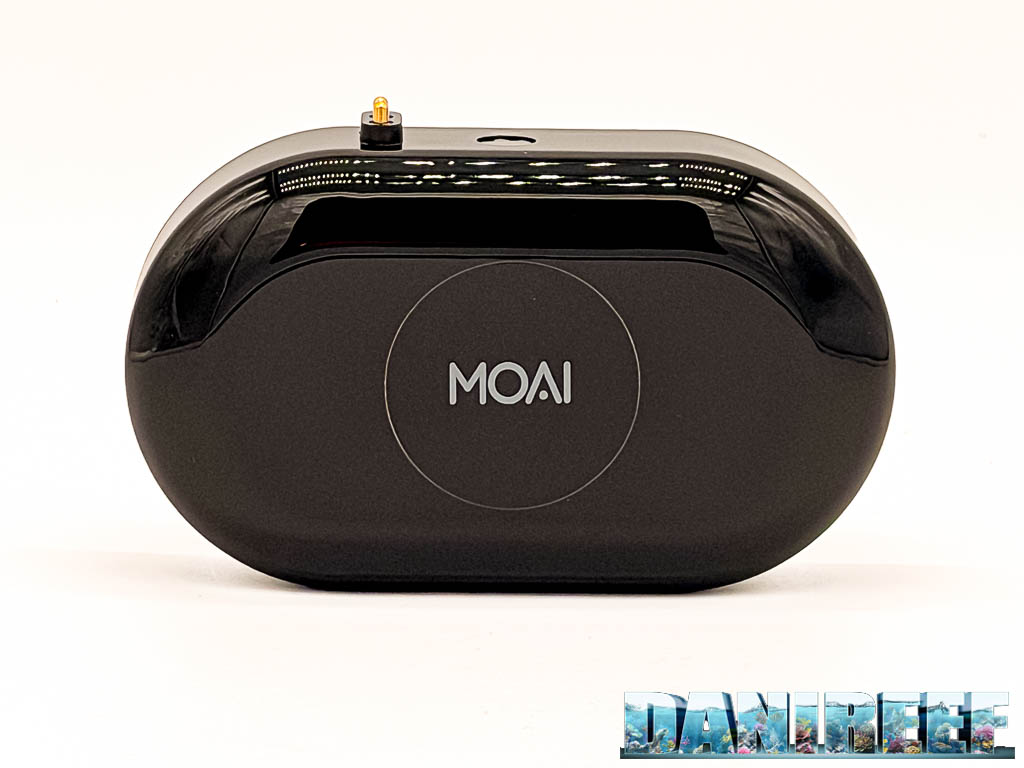
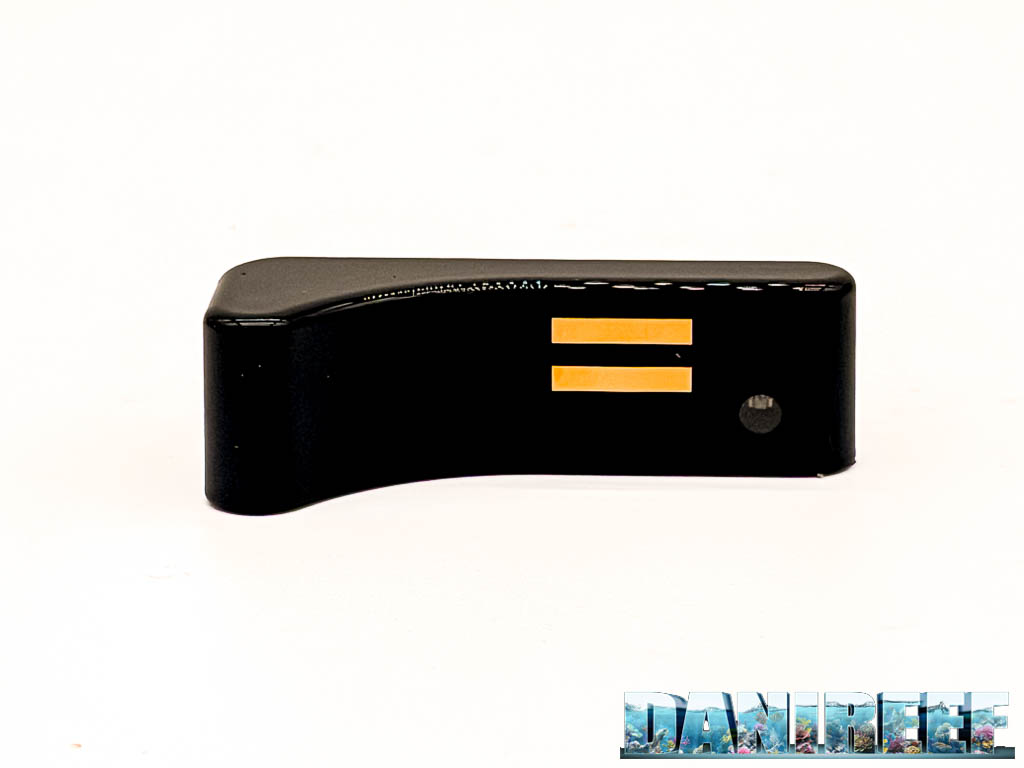
MOAI is a robotic aquarium glass cleaning system consisting of an external motorized unit, an internal magnetic element with a cleaning pad and a charging station installed on one side of the tank.
Its operating principle is similar to that of traditional magnetic glass cleaners: one element remains outside the aquarium and, through the glass, pulls the submerged part along with it. The difference is that in this case the movement is not provided manually by the aquarist. The robot moves across the surface by itself, following the area defined during configuration.
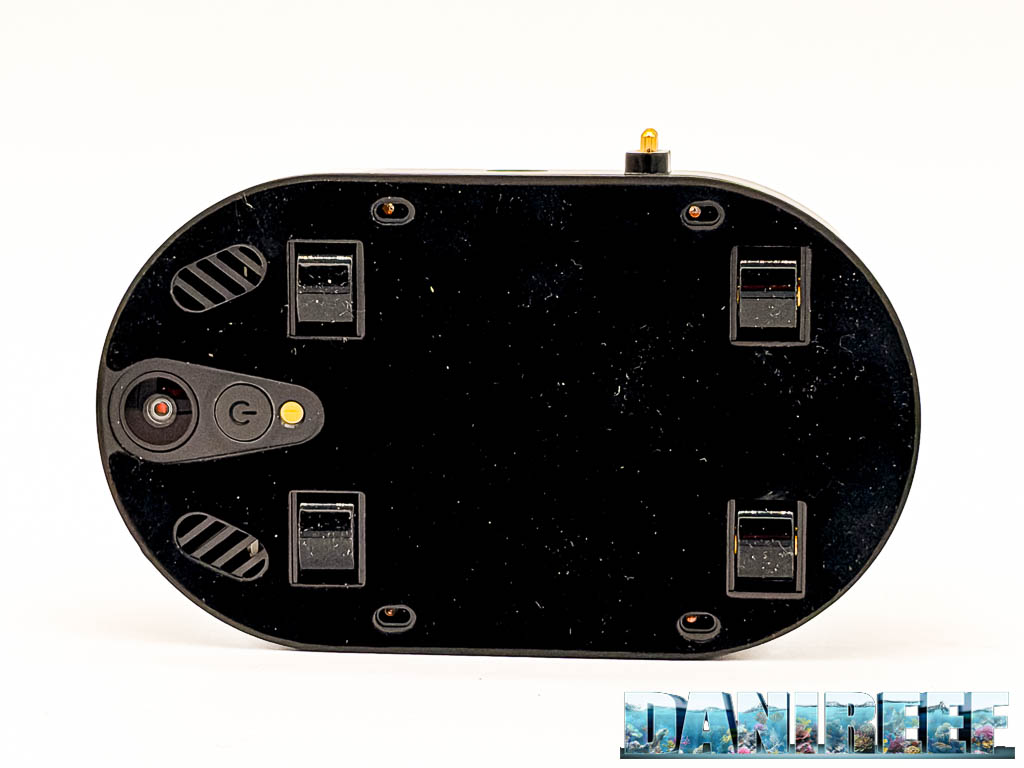
Once cleaning is complete, MOAI can return to its base, where spring-loaded contacts allow it to recharge. The system also uses ultrasonic sensors to determine its distance from the station and orient itself while moving.
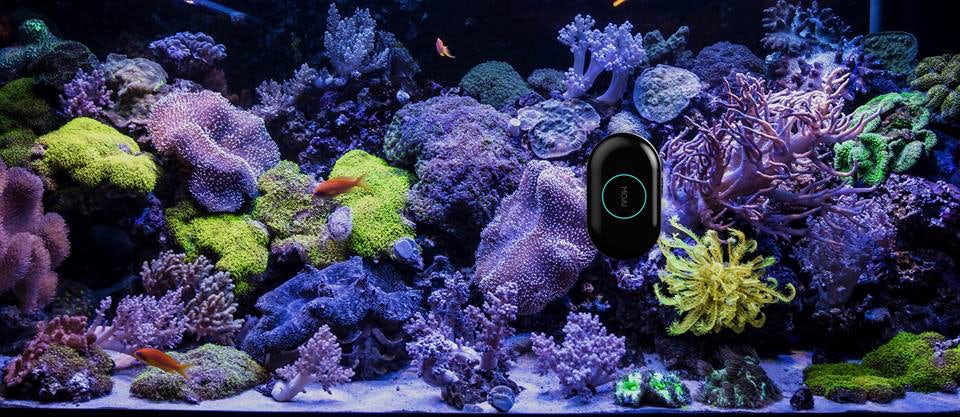
Inside the external unit we also find the most interesting feature of the product: a Full HD camera connected to the Wi-Fi network, through which we can observe the aquarium, move the viewing position and save photographs or videos directly from the app, together with a small integrated white LED.
The main technical features of MOAI
MOAI combines two different devices: an aquarium glass cleaning robot and a camera dedicated to observing the aquarium. The following table summarizes the main specifications declared by the manufacturer together with those we found on our unit.
| Main function | Automated aquarium glass cleaning and video monitoring |
| Video resolution | Full HD 1080p |
| Field of view | 130° diagonal |
| Connectivity | 2.4 GHz Wi-Fi |
| Lighting | Integrated white LED |
| Image correction | Exposure compensation and blue color cast adjustment |
| Video modes | Spot Mode and Cruise Mode |
| Navigation | Ultrasonic detection system |
| Charging | Automatic return to the charging station |
| Cleaning | Replaceable pads for the external and submerged sides |
| App | MOAI smartphone app |
| Compatible materials | Glass and acrylic, using the dedicated pad |
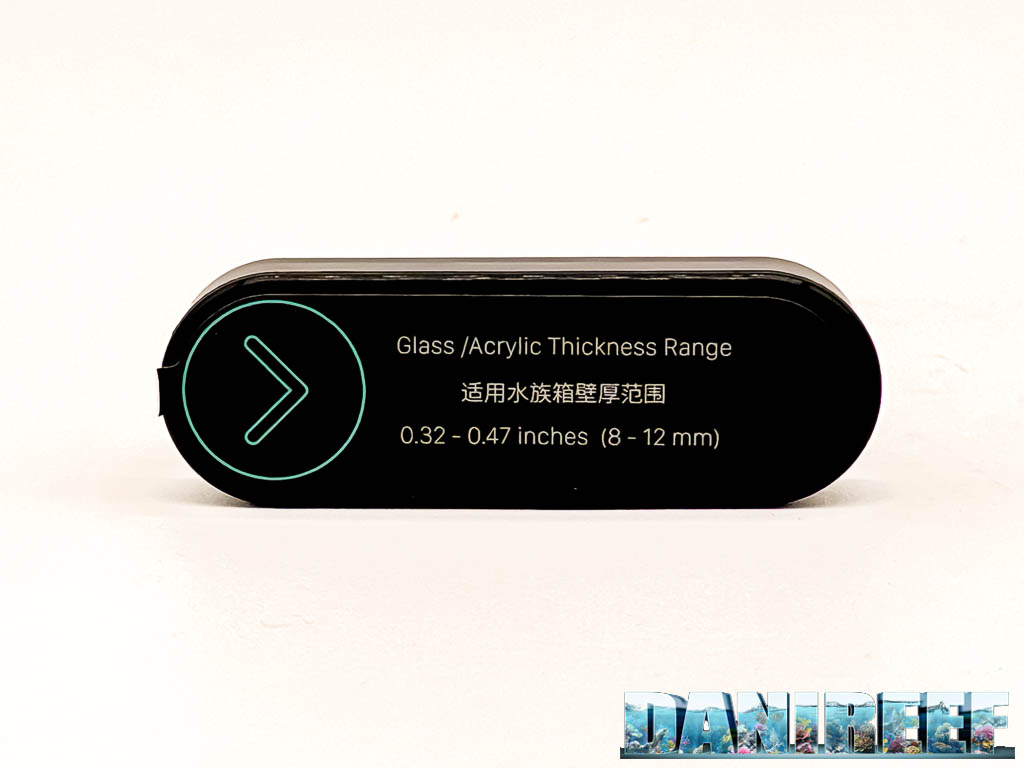
| Available thicknesses | 10–13 mm or 15–19 mm, depending on the version |
| Dimensions | 85 × 140 mm |
| Approximate price in USD | $399 in July 2026 ($379 with the DANIREEF discount) |
| Approximate price in EUR | €350 (€333 with the discount) |
MOAI can be used both on glass aquariums and on acrylic tanks, by choosing the specific internal pad supplied in the package. With acrylic, it is even more important to use only the appropriate material, frequently check that no grains of sand or debris are trapped in the pad, and maintain an adequate safety margin above the bottom, because acrylic is more sensitive to scratches than glass.
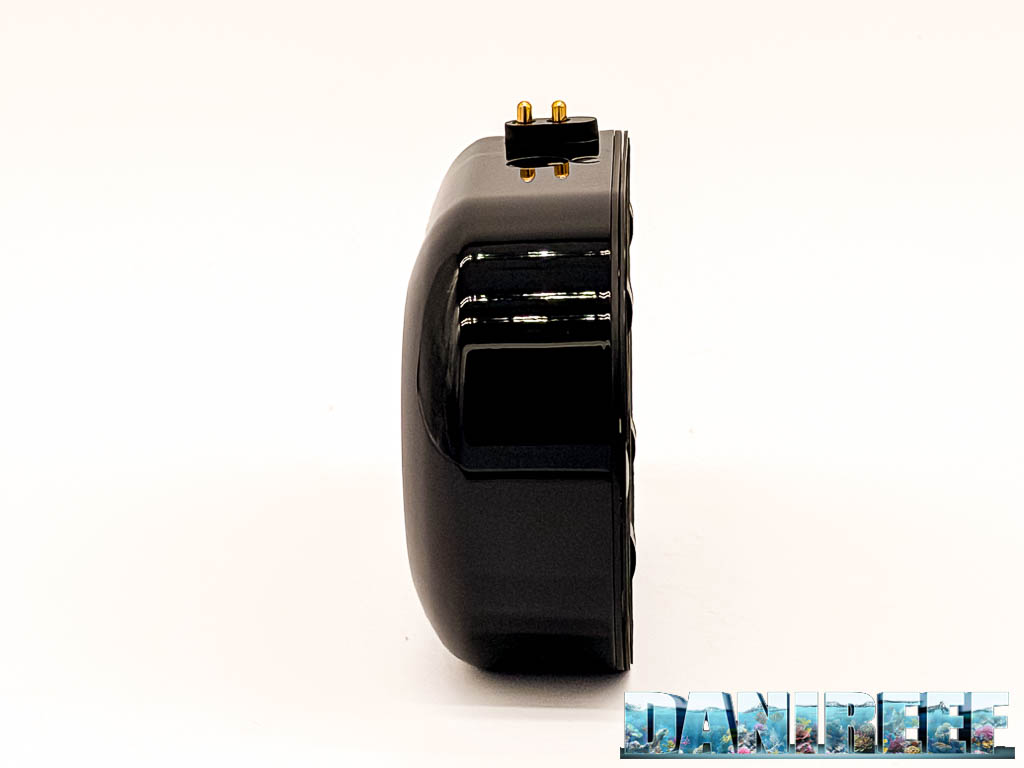
It is important to carefully check compatibility with the thickness of the aquarium wall and use the magnet designed for that specific configuration. Incorrect magnetic force could compromise the robot’s movement, place unintended strain on the drive system, or even cause the robot to fall to the floor. We have the 10–13 mm version, but a version for 15–19 mm thicknesses is also available for an additional cost of around twenty dollars.
Unboxing: what do we find inside the box?
The package is very comprehensive and includes everything needed for installation. In our case we found:
- the MOAI robot;
- the charging station;
- the internal magnet;
- the internal pads specifically designed for glass and acrylic surfaces, as well as the pad for the external side;
- the power supply;
- adhesive pads for securing the base;
- clips for organizing the cable;
- the accessories required for installation and maintenance.
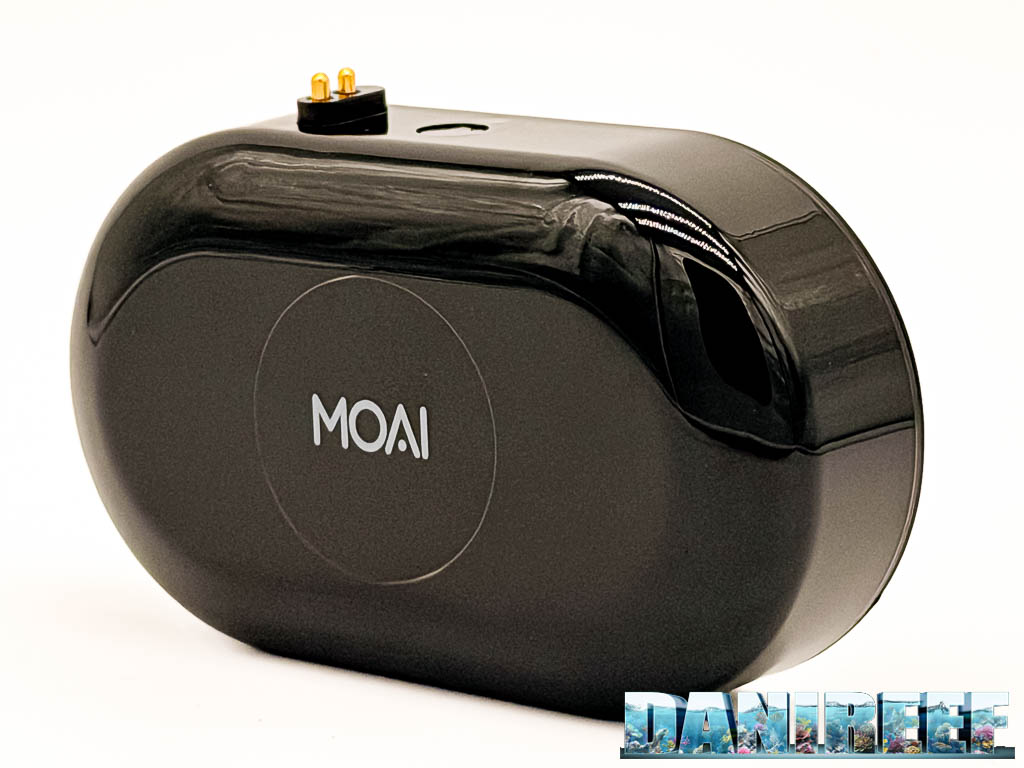
Our first impression is that of a product that has finally reached maturity. The design, which had already caught our attention back in 2016, remains one of MOAI’s distinctive features. The robot looks futuristic, and its shape serves a specific purpose: it allows the central camera to maintain a wide field of view while the system moves across the glass.
How do you install MOAI on an aquarium?
Installation requires a little more care than a simple magnetic glass cleaner, but the individual steps remain fairly simple and intuitive. Before starting, it is essential to thoroughly clean the glass where the station will be attached and make sure there are no grains of sand on the internal pad. For this purpose, MOAI provides convenient alcohol cleaning wipes.
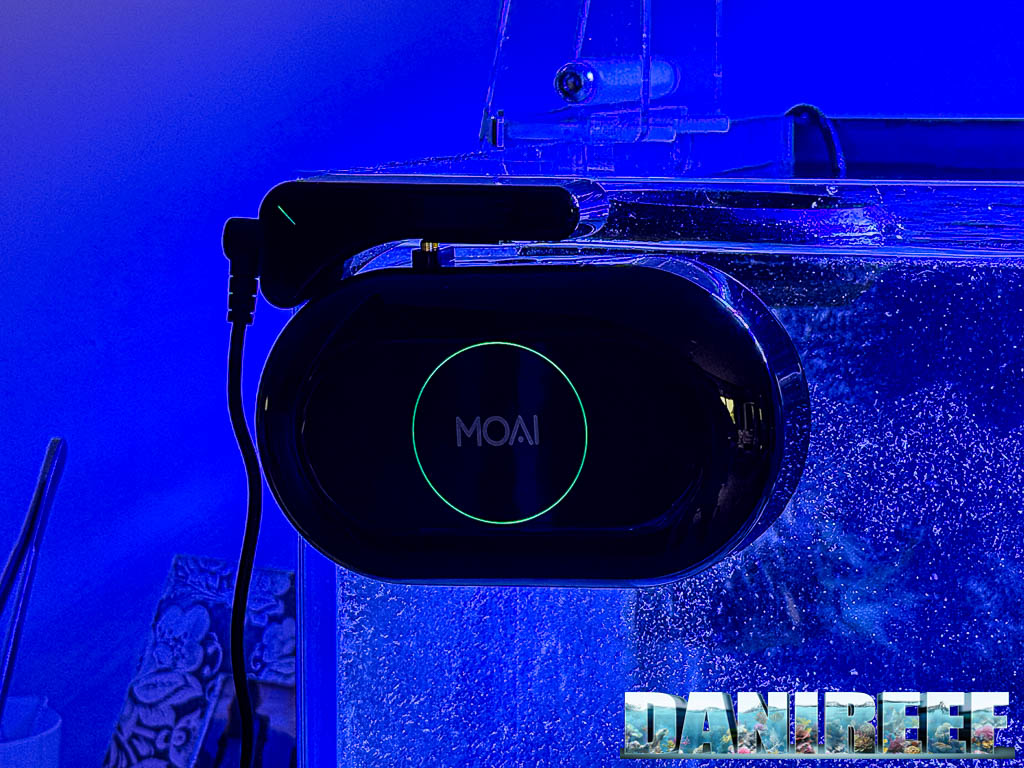
On our aquarium we positioned the base in the upper left corner, following the setup shown in the manual and in the manufacturer’s tutorials. The next steps are to install the internal pad, couple the two parts through the aquarium glass and connect the power supply.
Configuration continues through the MOAI app, connecting the device to a 2.4 GHz Wi-Fi network. From the app, you need to define the working area by setting a lower limit that keeps the pad at a safe distance from the bottom. In our Nyos Opus Pro aquarium, the tank design already reduces this risk. The front glass is recessed by a few centimeters in relation to the cabinet, preventing the robot from moving all the way down to the sand. Even so, we set an additional safety margin.
Be careful with sand
As with any magnetic glass cleaner, a grain of sand trapped between the pad and the glass could cause scratches. The ability to set a safety margin above the bottom is therefore very useful, but it does not replace periodic checks and proper cleaning of the pads.
The MOAI app: configuration and functions
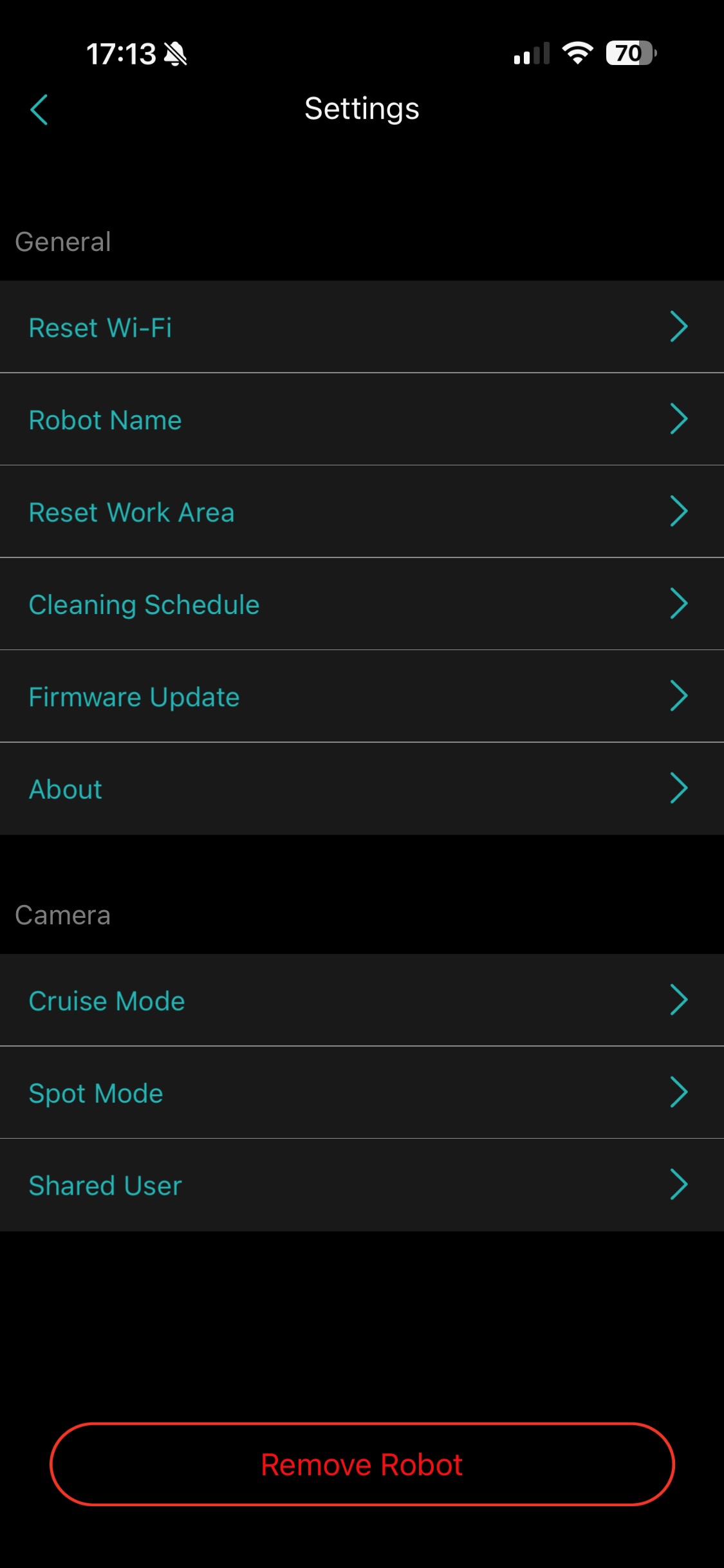
The app is the true control center of the system. From here we can start or stop cleaning, schedule cleaning cycles, check the robot’s position and access the camera.
Cleaning can be scheduled on the desired days and at the desired time, with a maximum of one automatic cycle per day. In normal use, we did not find this to be a significant limitation, because one daily pass is already more than enough to prevent the normal algae film from building up.
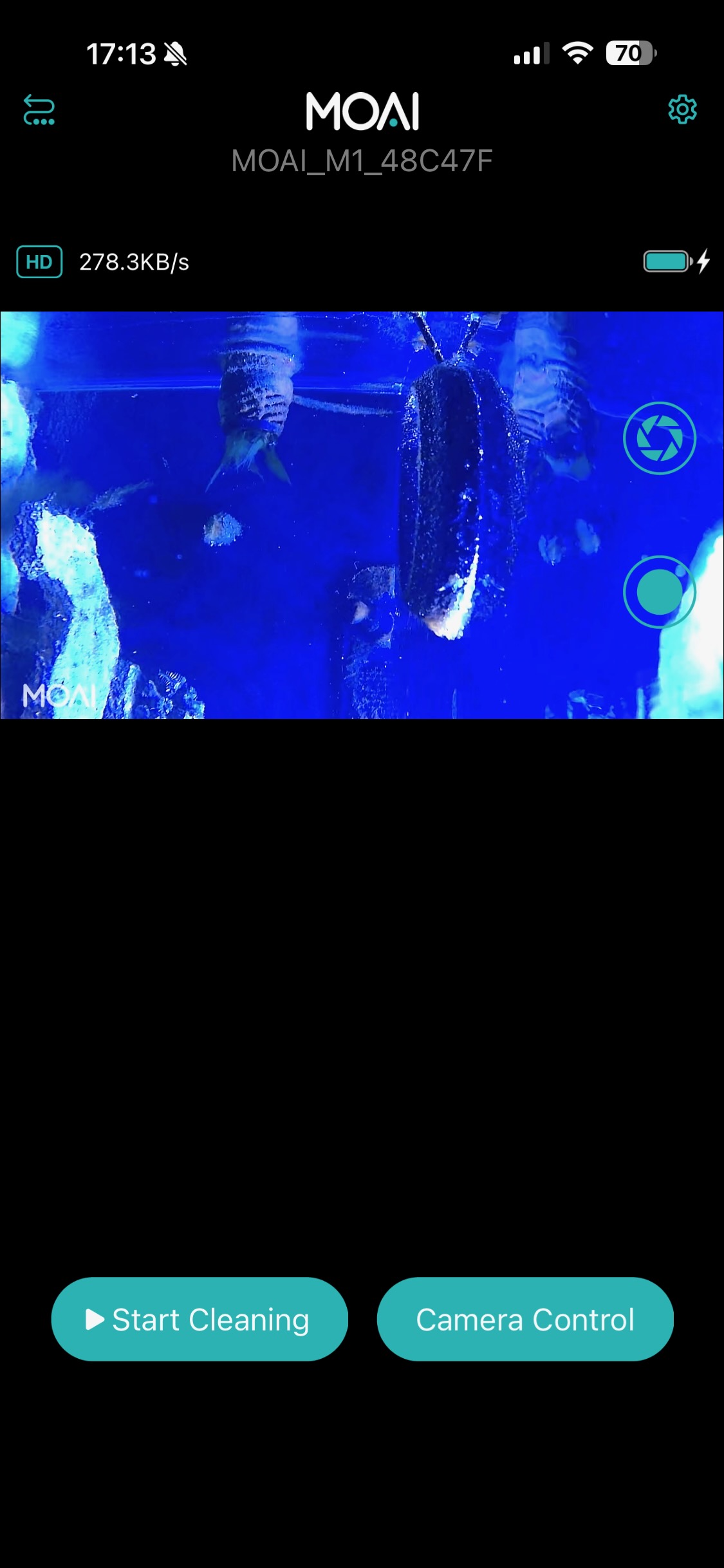
MOAI can also be used as a remote monitoring tool. The video stream allows us to check the aquarium when we are away from home, observe the animals’ behavior and quickly make sure that everything appears to be normal.
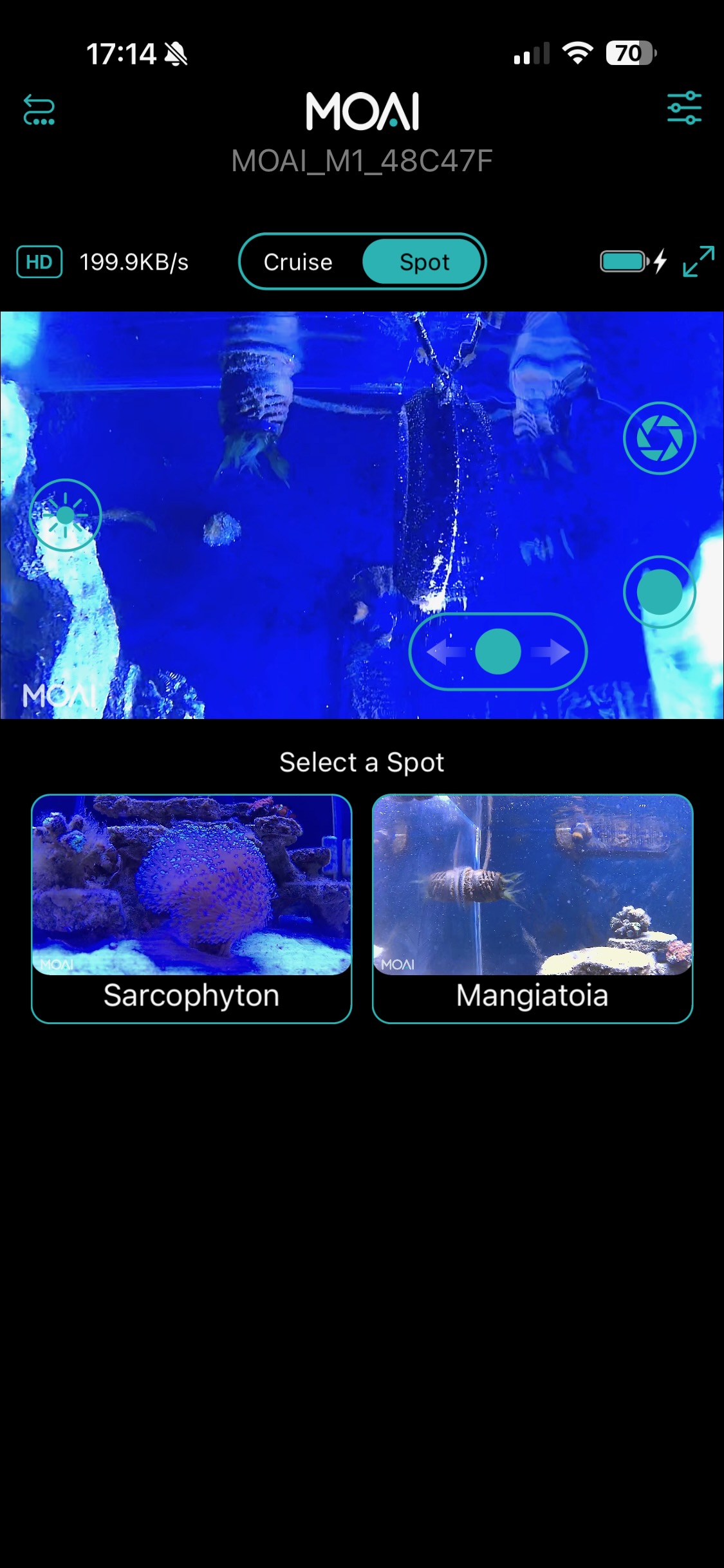
The app also allows us to save favorite positions, called Spots, turn on the integrated white light, compensate for exposure and correct the strong blue color cast typical of reef aquariums illuminated with LEDs. This last feature is particularly interesting because it eliminates the need to physically place a colored filter in front of the lens, and I have to say that despite the power of my lights, it works remarkably well.


In our test, the initial setup was very straightforward, especially when following the tutorial. The connection remained stable at all times and we experienced no connectivity issues. The app is streamlined and easy to understand even without being particularly fluent in English (the only language available besides Chinese), although there is still room for improvement. In particular, when cleaning is started manually, the app must remain open: if you leave the app, MOAI stops the cycle and returns to its base. This limitation does not apply to scheduled cleaning cycles, which are carried out autonomously.
Spot Mode and Cruise Mode
The two modes dedicated to observing the aquarium are called Spot Mode and Cruise Mode.
Spot Mode
With Spot Mode we can guide MOAI to a specific point on the glass and save that position so we can return to it later. For example, we can position MOAI in front of a coral or another area we want to monitor and save that location. Then we simply tap its name and picture, and the robot moves directly to the saved position. This is extremely convenient, especially when accessing the aquarium remotely, because there is no need to manually steer MOAI.
This feature is very useful for directly observing a coral colony, checking an area that is difficult to see from the normal viewing position, or following an animal’s behavior. Imagine creating an archive with a dedicated Spot for each of your corals. By taking pictures repeatedly from exactly the same position, you could also see just how much they are growing over time.
Cruise Mode
In Cruise Mode, on the other hand, we can define a height and let the robot move horizontally across the glass. This allows the camera to travel along the aquarium, providing a panoramic view and a much more dynamic perspective than a fixed camera.
How well does MOAI clean the glass?
The most important question, of course, remains: does MOAI really clean the glass well?
The system is not designed to remove particularly stubborn deposits or well-established coralline algae. Its main purpose is to regularly move across the surface and prevent the buildup of the thin algae film, keeping the glass clean for longer and reducing the need for manual cleaning.
It is therefore more accurate to consider it a preventive maintenance tool rather than a scraper designed for heavy-duty cleaning. After all, the same principle applies to many domestic robots: they work best when used frequently, before dirt becomes difficult to remove.
The results of our cleaning test
To make the result clearly visible, we allowed a normal surface algae film to build up on the glass. MOAI completed a single pass, although some sections probably overlap slightly along the route, taking approximately 18 minutes to clean an area of about 70 × 45 cm.
The result on normal algae film was excellent: the glass became perfectly clear again, with the only exceptions being the narrow strips that the cleaning pad physically cannot reach. On our aquarium, approximately 1 cm remains along the side edges and around 2 cm at the top, while the lower margin depends on the limit set during configuration.
We did not test MOAI on established deposits or particularly stubborn algae, because that is not the type of cleaning it was designed for. When used regularly, its job is precisely to prevent the normal algae film from developing into something more difficult to remove.
During operation, the motor is clearly audible in a quiet room. It is not particularly annoying, but it certainly does not go unnoticed. Scheduling makes it possible to have the robot work when we are not around or at times when the noise is less intrusive. During normal use, we experienced no problems with connectivity, navigation or returning to the charging station.
The camera: MOAI’s real strength?
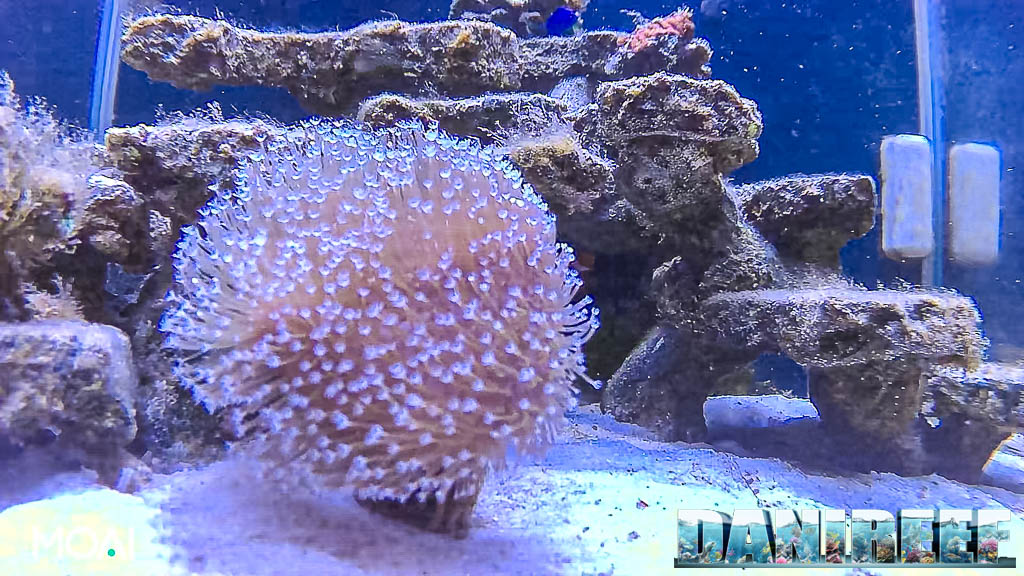
Probably yes. Because robots and magnetic automated cleaners can mainly be compared in terms of their cleaning effectiveness, but a camera that moves across the aquarium glass completely changes the way the device can be used.
The declared resolution is Full HD 1080p, with a 130-degree diagonal field of view and digital zoom. The lens has been designed to work close to the aquarium glass, while the anti-reflective coating should help reduce interference caused by room lighting.
The ability to adjust exposure and correct the blue component is particularly important in a reef aquarium. Standard cameras and smartphones often produce images that are excessively blue and very different from what we actually see with our own eyes.
MOAI also integrates a small white LED, useful for illuminating dark areas of the tank or observing animals when the main aquarium lights are switched off. Of course, it cannot replace proper photographic lighting, but it expands the ways in which the system can be used.
Image quality in our aquarium
The camera quality proved to be more than good enough for remote monitoring and for watching video directly on a smartphone. The level of detail makes it easy to recognize fish, check the overall condition of the tank and observe corals from a very close perspective.
Photographs, on the other hand, can be more affected by the movement of coral polyps and fish, while image quality decreases when the subject is too close to the internal magnet. This is therefore not a camera designed to replace a proper photographic camera, but rather to quickly observe and document what is happening inside the aquarium.
What the integrated blue correction does, however, is genuinely impressive. Even with our strongly actinic lighting, the correction produces much more natural colors and allows us to see the aquarium properly without placing physical filters in front of the lens. From this point of view, it passes with flying colors.
Streaming remained smooth and stable throughout our test. The small integrated white LED is very useful when the aquarium lights are off, because it allows us to illuminate the area being viewed and check the animals even in the dark. On the other hand, it becomes practically irrelevant when the main lights are on, especially at high intensity.
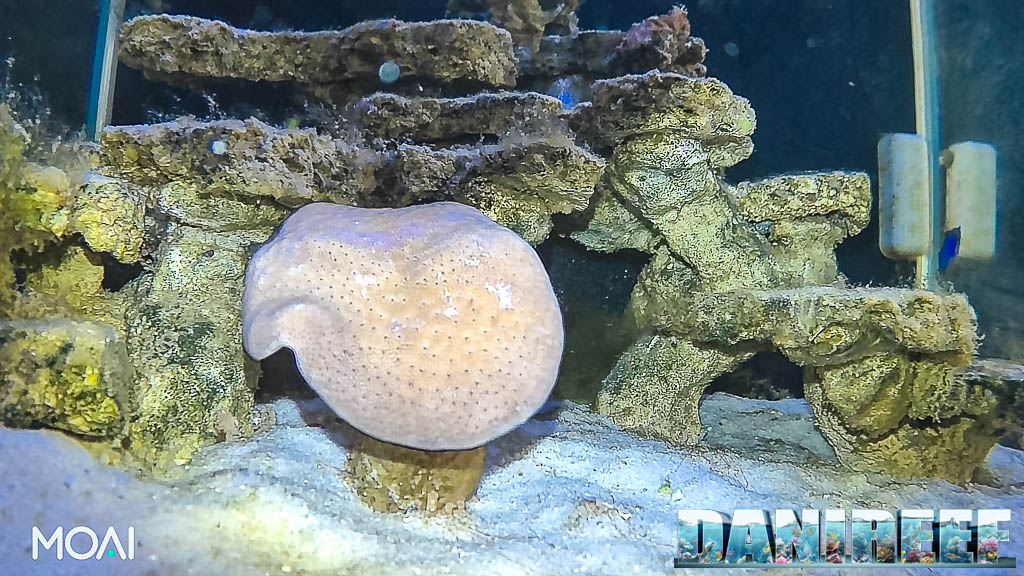
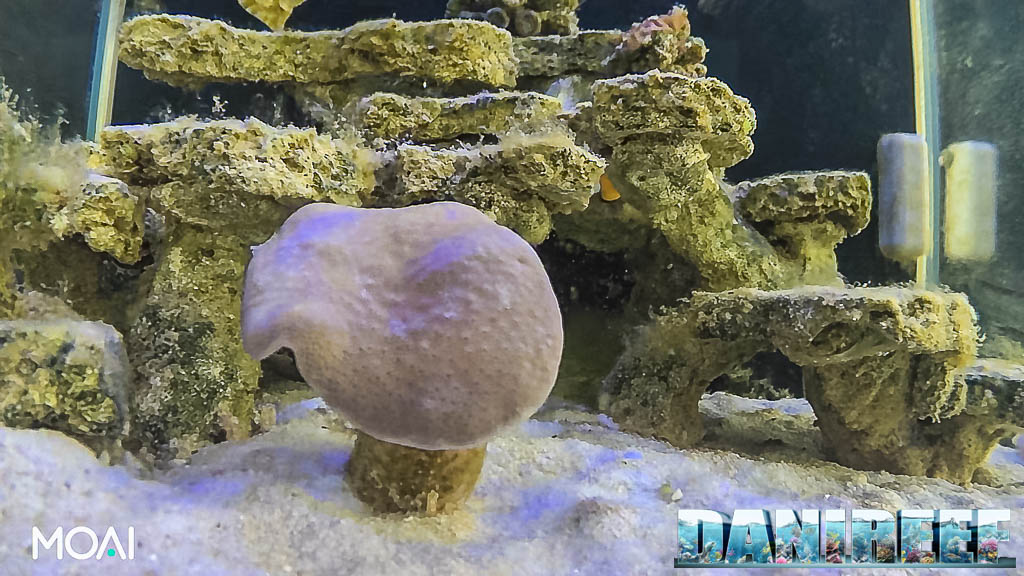
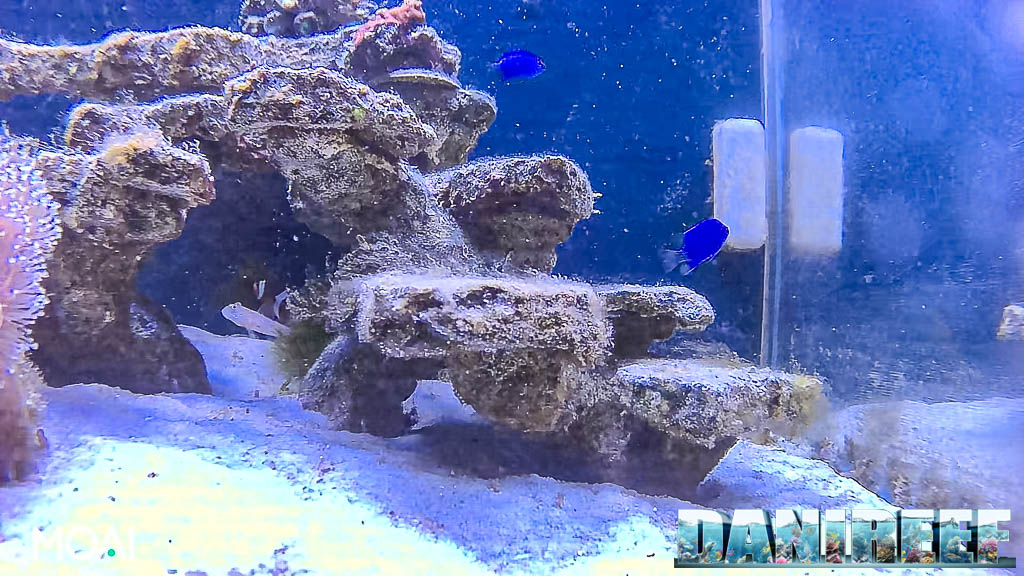
Overall, the photographs and videos saved through the app are also of good quality and more than adequate for the purpose for which MOAI was designed.
MOAI as a remote monitoring system
The camera is not just there to capture interesting images. Being able to connect remotely to the aquarium can be useful when we are at work or travelling, especially for a quick visual check of the tank.
Of course, we cannot consider MOAI a complete monitoring system: it does not measure temperature, pH, water level or power consumption, and it cannot replace a dedicated aquarium controller. However, it does allow us to check whether the water looks clear, whether the lighting is on, whether the fish are behaving normally and whether there are any obvious problems in the area being viewed. All of this comes with the significant bonus of doing so through clean glass that stays free of algae even after several days away from home.
Compared with a fixed camera, the advantage is the ability to change the viewing angle. We can move closer to a specific area, travel along the aquarium glass and save the positions we want to check most frequently.
What we liked about MOAI
The first thing that stands out is the originality of the concept. MOAI is not just another variation of an accessory already available on the market, but a device that attempts to create a new category by combining aquarium maintenance and observation.
- The concept is genuinely innovative: cleaning and a mobile camera coexist in the same device;
- The camera changes the perspective: we can observe the aquarium from just a few centimeters away and move the viewing angle;
- Blue light correction is extremely useful in reef aquariums illuminated predominantly with actinic light;
- Scheduled cleaning can save time and reduce the buildup of algae film;
- The safety margin above the sand addresses one of the main risks associated with magnetic glass cleaners;
- The design is refined and distinctive, without looking like a prototype adapted for aquarium use.
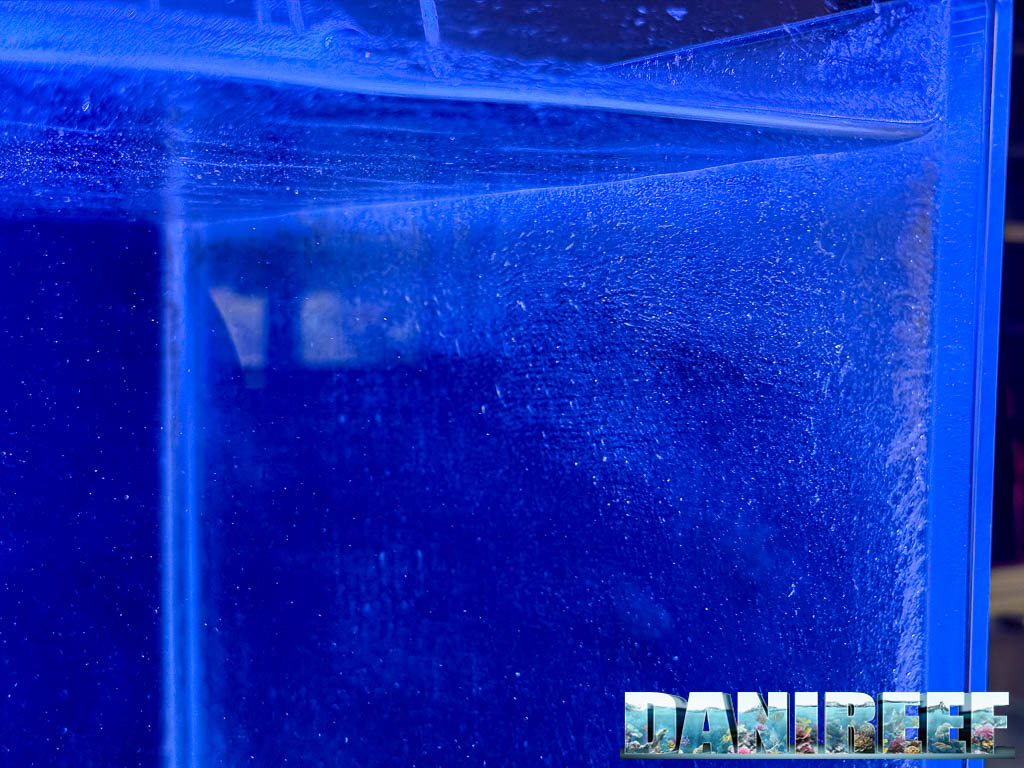
After following the project for almost ten years, we honestly feared that we might still find ourselves facing an immature product. Instead, our first impression is that of a carefully designed system, in which the different functions have not simply been placed side by side, but work together in a coherent way.
What could be improved?
Such an unusual product must also be evaluated in terms of what it could become through future app and firmware updates. The technological foundation looks interesting, but the day-to-day experience depends on software stability, navigation accuracy, spare parts availability and long-term support. These are all aspects that we cannot fully evaluate at this stage.
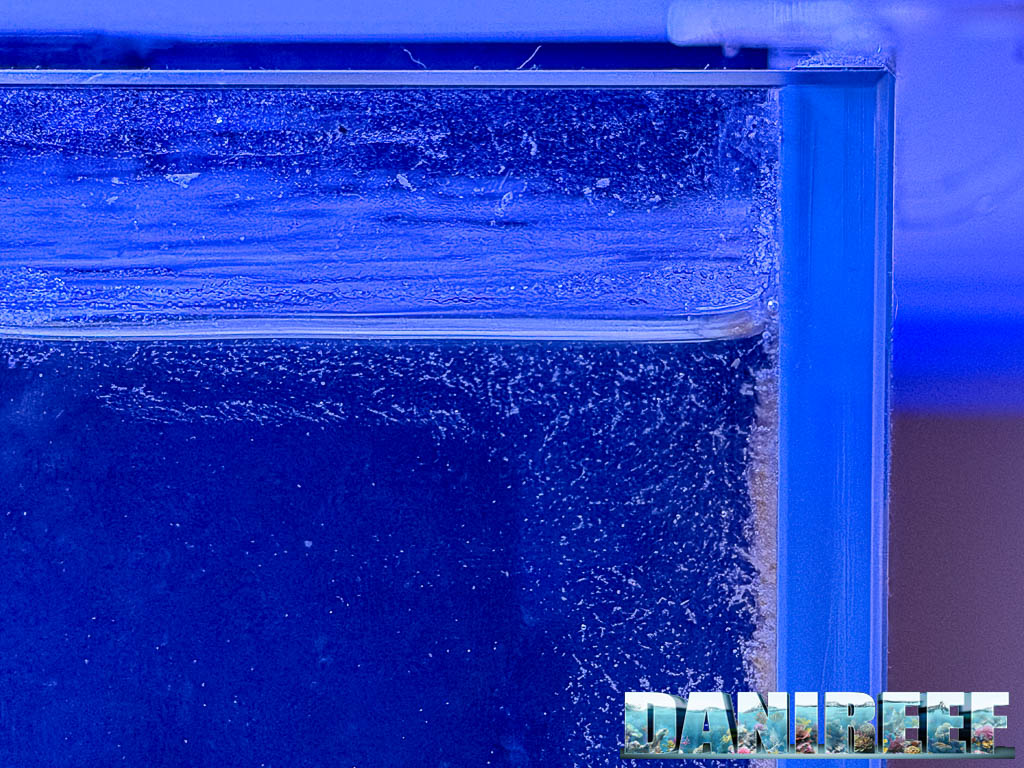
The presence of the robot on the glass is also much more noticeable than a small manual magnetic cleaner. Its visual impact is inevitably greater on smaller aquariums like ours, while on 130, 150 or 200 cm front panels its dimensions become proportionally much less significant. Anyone looking for a completely invisible solution will still need to consider the size of the external unit and charging station in relation to the dimensions and position of their aquarium.
Finally, MOAI does not eliminate every manual intervention. The pads need to be checked and cleaned, areas close to the bottom require caution, and the most stubborn deposits will probably still require a traditional scraper. And above all, the other sides of the aquarium (unless you decide to buy three MOAIs!), as well as the narrow strips along the side edges, still need to be cleaned manually.
What you need to know before buying
The three main limitations that emerged during our test are the high price, the visual footprint, especially on smaller aquariums, and the fact that each unit can naturally work on only one pane of glass. There are also some characteristics inherent to the system which are not necessarily flaws, but should be considered before purchasing.
- it remains visible on the front glass, with a footprint of approximately 14 × 8.5 cm;
- the charging station and power cable remain permanently in place;
- each unit cleans only one pane of the aquarium;
- its path must be free from pumps, sensors, brackets, feeders and other equipment attached to the glass;
- the edges and areas that cannot be reached by the cleaning pad still need to be cleaned manually.
Who is MOAI for?
MOAI can be particularly interesting for anyone with a medium-to-large aquarium who wants to keep the glass clean through frequent passes and likes being able to check the tank even when away from home.
It is also a product aimed directly at technology-loving aquarists. Anyone already using controllers, smart plugs, cameras or home automation systems will find it quite natural to add a device to the aquarium that can move, clean and provide real-time images.
It may be less interesting for very small aquariums, tanks with strongly curved glass, or setups where rocks, pumps and other elements come very close to the front surface. Before purchasing, it is therefore essential to check the characteristics of your tank and the compatibility specified by the manufacturer.
Is MOAI worth the price?
The answer inevitably depends on how we evaluate the price, the size of the aquarium and the value we place on the camera. Judging MOAI solely as an automatic glass cleaner would in fact be reductive: a significant part of its value comes from the ability to explore and monitor the aquarium remotely.
MOAI costs $399, which is approximately €350 at the current exchange rate. However, using our direct link you can save 5%, bringing the total down to a more affordable approximately €330. If you purchase through this link, you will receive the discount and DaniReef may receive a commission, at no additional cost to you.
Anyone who simply wants to manually remove algae film from the glass will continue to get good results with a much less expensive magnetic cleaner or scraper. Those looking for a technologically advanced, programmable device capable of offering an entirely new perspective on the aquarium will find in MOAI something that, at the moment, has very few direct competitors.
The discounted price is indicative and may vary depending on exchange rates, shipping costs and any applicable fees or taxes.
The price-to-quality ratio cannot be evaluated in the same way as a normal magnetic cleaner, because a substantial part of the value lies in the mobile camera, automatic cleaning and remote control. Both quality and price are high. On a large aquarium, where its physical presence becomes proportionally less noticeable and manual cleaning is more demanding, the purchase becomes easier to justify. MOAI is quite visible on our aquarium, but after integrating it into our daily maintenance routine, we would still find it very difficult to give it up.
Transparency note: MOAI was provided to us free of charge by the manufacturer solely to allow us to test it and produce this review. The content of this article nevertheless reflects our direct experience and our independent opinion.
Our conclusions on MOAI
After almost ten years of waiting, MOAI has finally become a real, usable product. That alone is an important achievement for a project this complex and so different from any traditional aquarium accessory.
Our impression is decidedly positive. The robot is well built, the design feels mature, and the combination of automated cleaning and a mobile camera does not feel like a mere technological exercise. The two functions complement each other: clean glass makes it possible to see inside the aquarium (and that should not be taken for granted), while the movement required for cleaning allows the camera to explore the tank.
The feature that intrigued us the most remains the ability to see the aquarium from a different perspective and check it remotely. Automatic cleaning is certainly useful, but it is the mobile camera that transforms MOAI into something more than a sophisticated motorized magnetic cleaner. The two functions support each other and together represent the real originality of the project.
Our verdict
Build quality: very good
Originality: excellent
Ease of installation: very simple
Cleaning performance: very good
Camera quality: good; it’s just a shame it isn’t 4K, but perhaps in the future…
App: works well, although in my opinion there is plenty of room for improvement
Price-to-quality ratio: excellent quality and a high price. Each of us can decide for ourselves where to set the bar
Overall assessment: we really like the concept and our first impressions are extremely positive. After integrating it into our regular maintenance routine, going back to manual cleaning alone would be difficult.
Of course, a definitive judgment on reliability will require much longer use. During the first few weeks, MOAI effectively kept algae film under control, always completed its scheduled cycles and correctly returned to its charging station. We still need to see how these results hold up after many months, how frequently the pads will need to be cleaned or replaced, and what the long-term availability of spare parts will be.
For further information, you can visit the official MOAI website.
What do you think? Would you trust a robot to clean your aquarium? And which feature do you find more interesting: automatic cleaning or the mobile camera? Let us know in the comments, or join the discussion with us on Telegram, Instagram, Facebook, YouTube and on the DaniReef forum.
Scopri di più da DaniReef - Portale dedicato a Acquario Marino e Dolce
Abbonati per ricevere gli ultimi articoli inviati alla tua e-mail.