




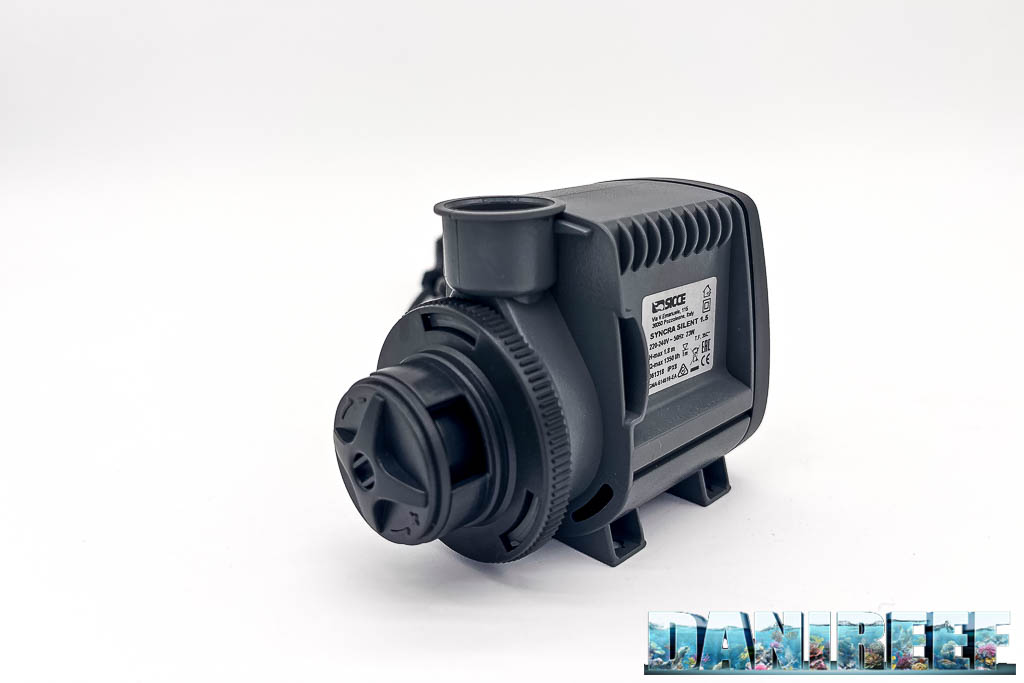
The Sicce Syncra Silent 1.5 is an old acquaintance of the DaniReef LAB. We tested it back in 2012, when we still used a vertical pipe to measure head and relied on Sicce’s laboratory equipment for flow. Fourteen years later we have measured an identical pump again with our own instruments. How much has changed? And above all, how close does it come to its rated values today? Let’s find out in our review.

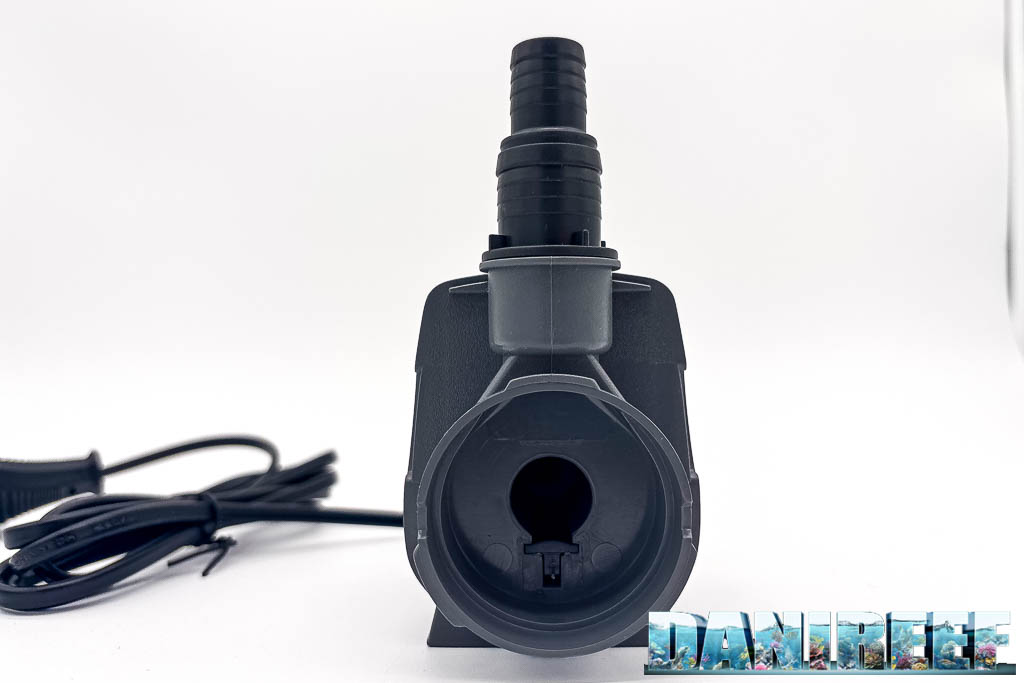
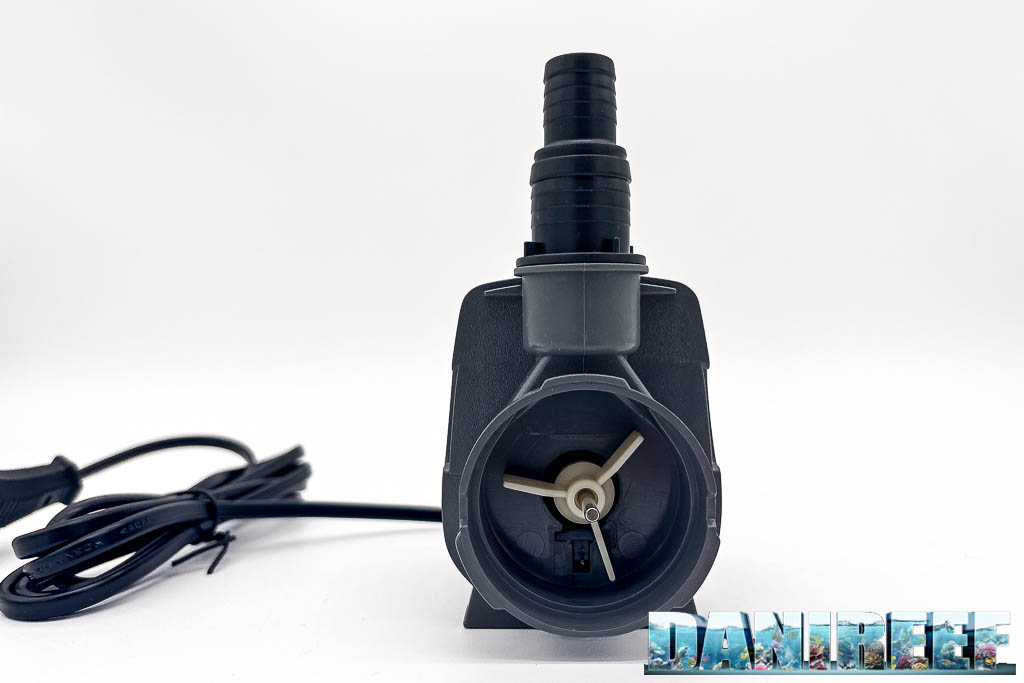
This is far from a brand-new pump, and that is exactly why we wanted to start again from it. The Syncra Silent 1.5 is an AC centrifugal pump with a rated flow of 1,350 l/h and a declared head of 1.8 metres. It has no electronic controller and no selectable power levels. It is a simple pump, designed for continuous operation, either submerged or inline according to the manufacturer’s instructions.
What makes this test interesting is that this time we measured flow, head and power consumption on the test bench we use in our most recent reviews. Please note that the unit used for this test is new. Even so, we can compare the results not only with the rated values but also with those we obtained in 2012. And, as we will see, the comparison also tells an interesting story about how our test methods have evolved.
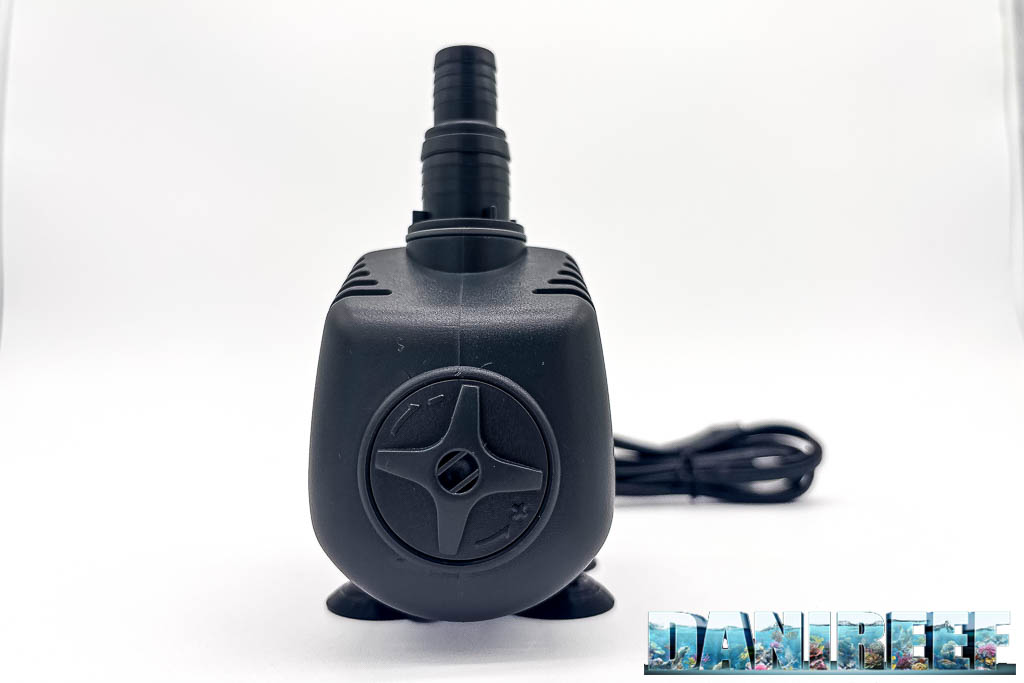
Sicce Syncra Silent 1.5 technical specifications
| Model | Sicce Syncra Silent 1.5 |
| Type | AC centrifugal pump, fixed flow with mechanical adjustment |
| Rated maximum flow | 1,350 l/h |
| Rated maximum head | 1.8 m |
| Rated power consumption | 23 W |
| Dimensions reported in our 2012 test | 103 × 60 × 78 mm |
| Use | Submerged or inline |
| Warranty stated on the current packaging | 5 years (3 + 2 with online registration) |
| Price | 54.95 euros |
The declared reference value, calculated with the method we have used in the DaniReef LAB for years, is 1,215 l·m/h: maximum flow multiplied by maximum head, divided by two. It is our own conventional index for placing pumps of similar size and performance side by side, not a measure of hydraulic efficiency nor of the actual area under the performance curve.
Construction and adjustment
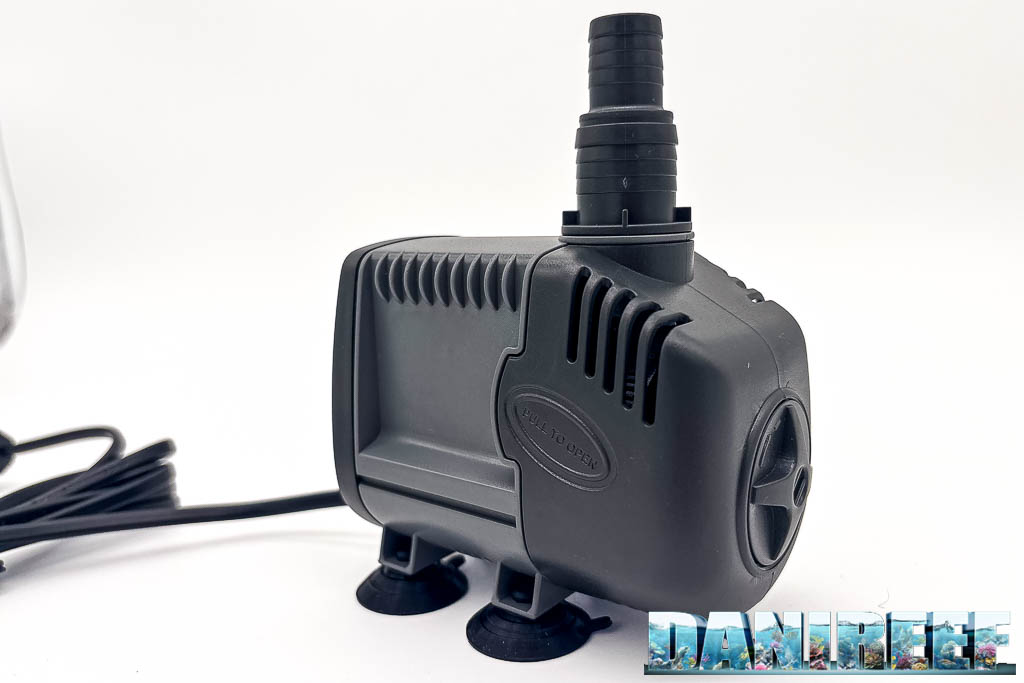
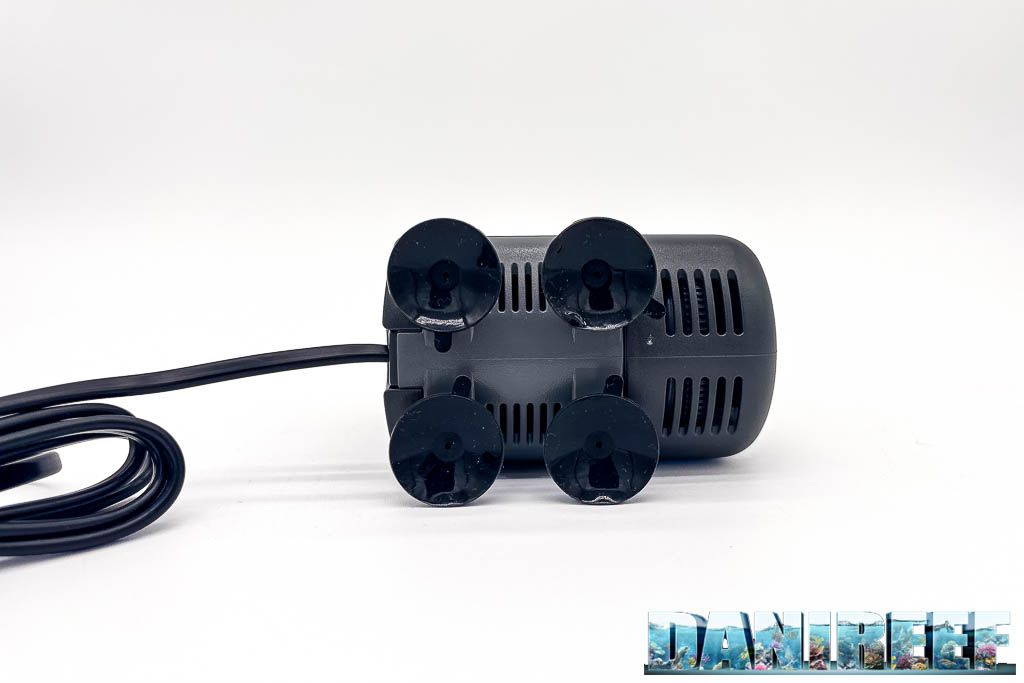
The Syncra Silent 1.5 belongs to the family of Sicce pumps we have known for many years. The body is compact and flow adjustment, when needed, is mechanical: there is no electronic controller, no programs to set and no power steps to measure. For our tests we used the fully open setting.
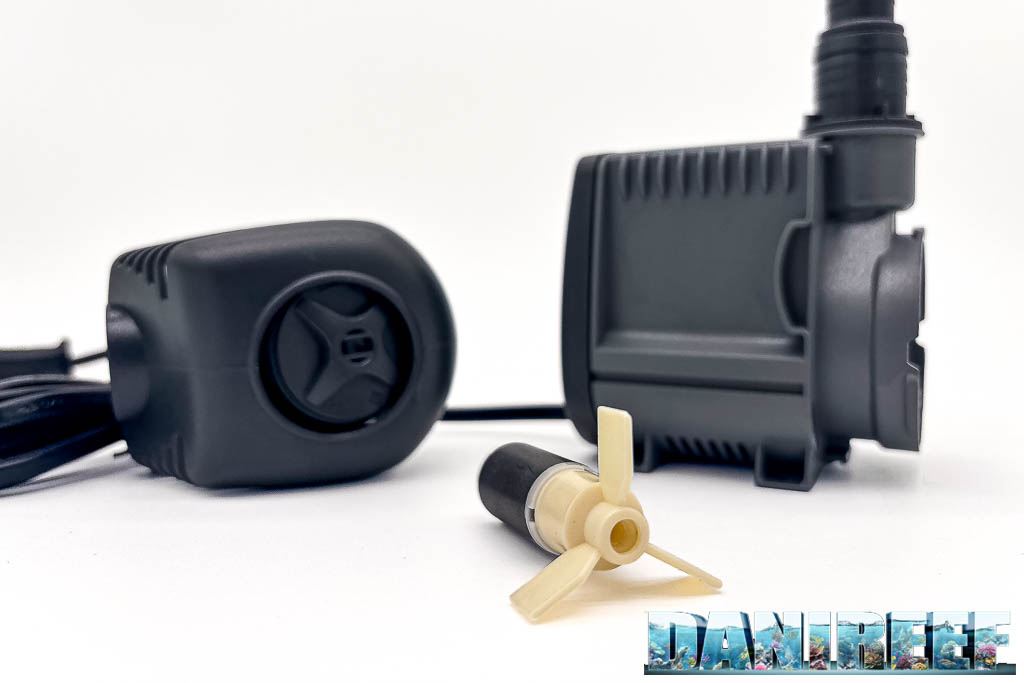
As always, when choosing a pump you also need to consider the diameter of the fittings and pipes you will use. Reducing the diameter too much, or a route with many bends, can lower the actual flow considerably.
Back in the DaniReef LAB, fourteen years later
In 2012 we measured the Syncra Silent 1.5 with two different systems (you can find that review here: Sicce Syncra Silent pumps 0.5, 1.0 and 1.5: The Total Comparative Test). In our first test, carried out with a vertical water column, we obtained 170 cm of head. Later, using the laboratory made available by Sicce, we recorded 173 cm of head and 1,132 l/h of flow, the latter however with a residual head of 39 cm. This is an important detail, because that figure did not represent flow at zero head.
Today we use different instruments. For flow we use the DigiFlow 6710M, for power consumption the RCE PM600 and, for head, an electronic pressure transducer connected to a digital indicator. The latter is the most important novelty compared with our previous reviews.
The transducer lets us read the pressure with the pump outlet closed downstream of the sensor, so we no longer need to run several metres of pipe vertically. It is an enormously more convenient method, especially for high-head pumps. We chose it with a wide measuring range, suitable even for pumps exceeding 10 metres of water column. On the other hand, at the relatively low pressures of this Sicce, its actual resolution and accuracy call for some caution.
Methodological note: for head we prudently apply an indicative margin of ±10% when reading the results. This is not a certified uncertainty nor an instrument calibration: the margin is a reminder that small deviations should not be read as definite performance differences. The result also depends on the position of the sensor relative to the water level, the fittings configuration and the conditions of the test bench. Comparisons with the 2012 measurements should therefore be read bearing in mind the change of method.
Head test
Let’s start with head, that is, the pump’s ability to overcome a difference in height. To measure the maximum value we fully closed the outlet after the pressure transducer, obtaining a zero-flow condition. The display read 0.16 bar.
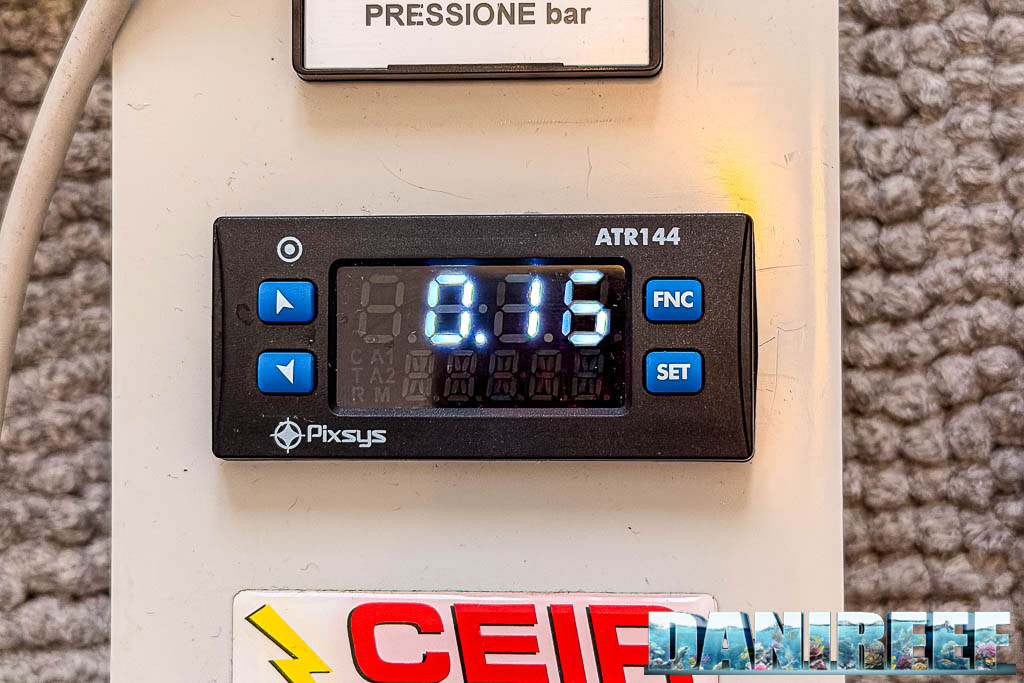
To convert pressure into metres of water column we use the relationship between pressure and hydrostatic height. With fresh water, 0.16 bar corresponds to about 1.63 metres. This is the value equivalent to the pressure read by the sensor.
| Syncra Silent 1.5 | Value |
| Rated head | 180 cm |
| Pressure read in the 2026 test | 0.16 bar |
| Equivalent water column | about 163 cm |
| Indicative deviation from rated value | −9.4% |
| Head measured in 2012, static method | 170 cm |
| Head measured in 2012, Sicce laboratory | 173 cm |
The result is interesting: 1.63 metres against the 1.80 declared, an indicative deviation of less than 10%. And we are also close to the values we obtained fourteen years ago, 170 and 173 cm respectively. Given the prudential margin we decided to apply, we would not attach any particular significance to the few centimetres of difference between the three tests.
Flow test
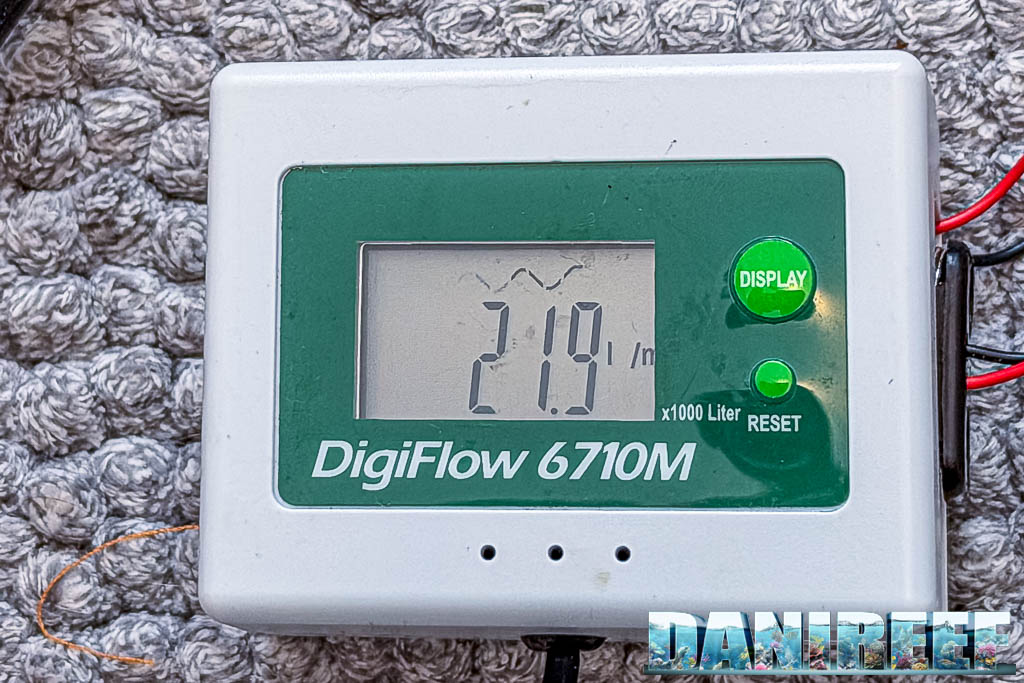
To measure flow we used our DigiFlow 6710M, which shows litres per minute directly. The test photo reads 21.9 l/min. Multiplying by 60 gives a flow of 1,314 l/h.
| Rated flow | 1,350 l/h |
| Flow reading | 21.9 l/min |
| Calculated flow | 1,314 l/h |
| Percentage of rated value | 97.3% |
| Deviation | −2.7% |
Here the result is definitely excellent. We know how hard it is for centrifugal pumps to match the values measured in the factory. Under the conditions of our test, the Syncra Silent 1.5 reached 97.3% of its rated flow. A minimal difference, especially considering that the fittings and the flow meter inevitably introduce pressure losses.
In 2012 we measured 1,132 l/h with the Sicce laboratory equipment, but with a residual head of 39 cm. It would not be correct to compare that number directly with today’s 1,314 l/h as if they were two identical tests: the hydraulic conditions were different. It is still interesting, though, that both tests return values consistent with the pump’s expected behaviour.
Remember that this is a flow measurement on our test bench, not the flow you will automatically get in your aquarium. A return line of one and a half metres, narrow pipes and 90-degree elbows can significantly reduce the water that actually reaches the tank.
Power consumption test
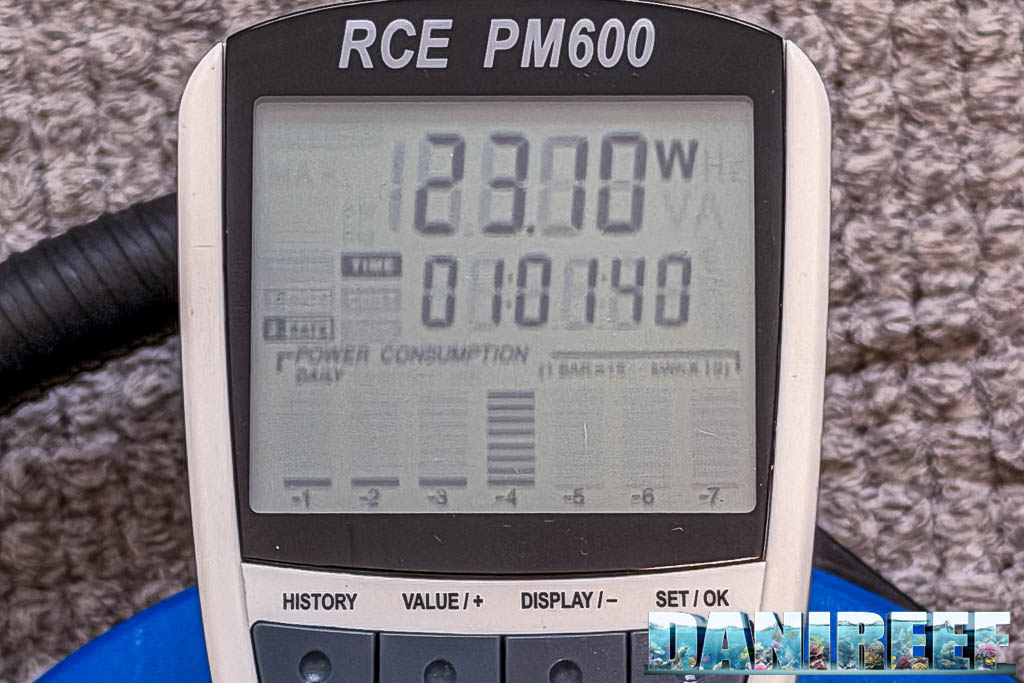
Power consumption was measured with our RCE PM600. The photo shows a draw of 23.10 watts, perfectly in line with the 23 watts declared by Sicce. For a pump that runs day and night, this is an important figure.
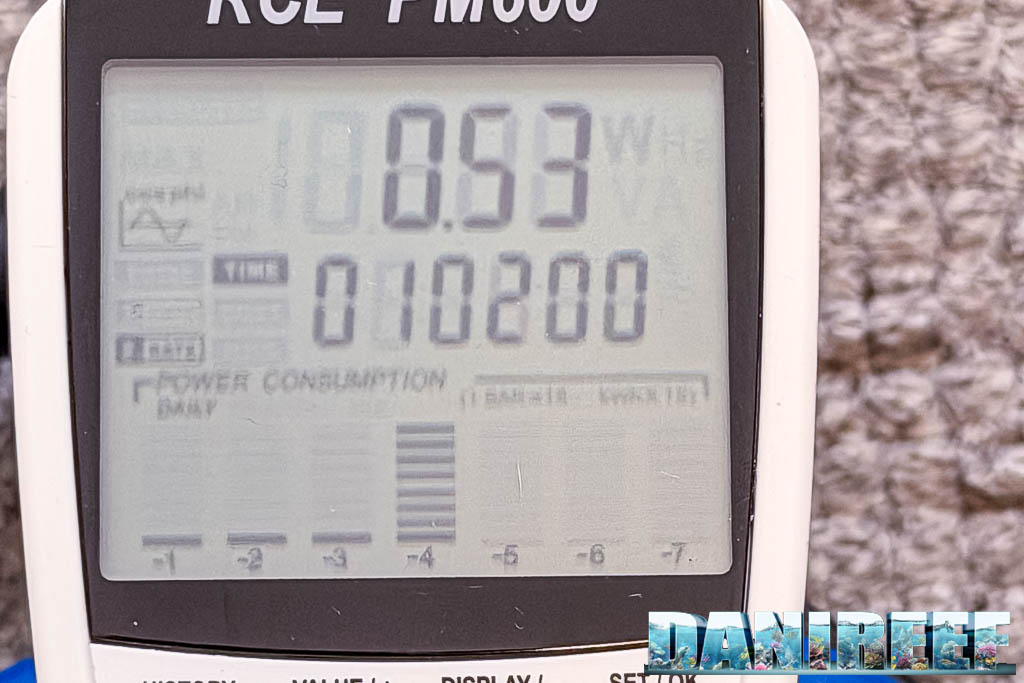
We also photographed the power factor (cos φ) screen, which reads 0.53. This value describes the ratio between active and apparent power at the measuring point; it should not be confused with the pump’s hydraulic efficiency and, on its own, it does not tell us how much energy is turned into heat.
| Rated consumption | 23 W |
| Consumption measured in 2026 | 23.10 W |
| Deviation from rated value | 0% |
| Power factor reading | 0.53 |
| Energy per year, 24/7 | 201.5 kWh |
| Yearly cost at 0.27 €/kWh | about 54.40 € |
Running continuously for 365 days, the Syncra Silent 1.5 would use about 201.5 kWh per year. At an energy price of 0.27 euros per kWh, the same value we use in many of our reviews to keep results comparable, that is about 54 euros per year, or just over 4.50 euros per month. Of course, the actual cost depends on your tariff.
In 2012, in the Sicce laboratory, we read 18.4 watts, but that measurement was taken at maximum head, so under different load conditions. The 4.6-watt difference should not be read as the pump getting worse: the consumption of a centrifugal pump can vary with its operating point.
Our comments
The Sicce Syncra Silent 1.5 performed well on our new test bench. Flow was very close to the rated value, consumption matches the manufacturer’s figure and head, despite the caution required by the new method, is essentially consistent with the rated data and with the measurements we took in 2012.
What struck us most is precisely this consistency: fourteen years later, with different instruments and conditions, we find a pump with no surprises in its key numbers. That does not make it the right choice for every aquarium, because its 1.8-metre head makes it unsuitable for demanding return lines. But for small systems, reactors or circuits with modest height differences, it remains an option worth considering.
Comparison with rated values
| Sicce Syncra Silent 1.5 | Rated | Measured 2026 | Deviation |
| Head | 180 cm | about 163 cm, from 0.16 bar | −9.4% (indicative) |
| Flow | 1,350 l/h | 1,314 l/h | −2.7% |
| Power consumption | 23 W | 23.10 W | +0.4% |
Flow practically matches the rated value. Consumption shows no difference either. Head is the figure that calls for the most caution, because the new transducer was chosen to work with much more powerful pumps too, and here we are in the low part of its measuring range. The result is nonetheless close both to the rated value and to our historical readings.
Conclusions
The measured reference value of the Sicce Syncra Silent 1.5 is about 1,071 l·m/h, against the 1,215 l·m/h derived from the rated values. The difference is about −11.9%, but it is also affected by the head estimate obtained with the transducer. It would make no sense to give this percentage more precision than the measurements allow.
What we can say is that the Syncra Silent 1.5 essentially keeps its promises. Measured flow is 97.3% of the rated value and consumption is exactly what the data sheet states. Head is consistent, within the caveats we have explained, with what we measured back in 2012. For a simple, fixed-flow pump, that is no small thing.
PROS
✓ Flow very close to the rated value
✓ Measured consumption matches the rated value
✓ Simple construction, no controller needed
✓ Results broadly consistent with our historical tests
CONS
− Limited head for more demanding return lines
− No electronic power adjustment
− Actual flow depends heavily on pipes and fittings
If you are choosing a return pump, we also recommend our in-depth articles How to choose the right return pump for marine aquarium and Return pumps: calculating the flow.
Editorial note: all measurements were carried out by the DaniReef LAB.
Disclaimer: We thank Sicce for providing the Syncra Silent 1.5 pump for this review. The pump was returned to the company at the end of the tests. The measurements and assessments in this article were carried out completely independently by the DaniReef LAB.
Let’s talk about it
If you have questions, doubts or curiosities about the Sicce Syncra Silent 1.5 or about choosing your return pump, leave a comment below the article or join us on the DaniReef forum. You can also find us on Instagram, Facebook and YouTube.
Scopri di più da DaniReef - Portale dedicato a Acquario Marino e Dolce
Abbonati per ricevere gli ultimi articoli inviati alla tua e-mail.

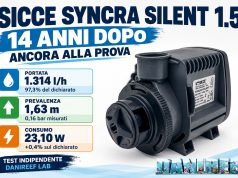









, 1.63 m head and 23.10 W, compared with our 2012 test)