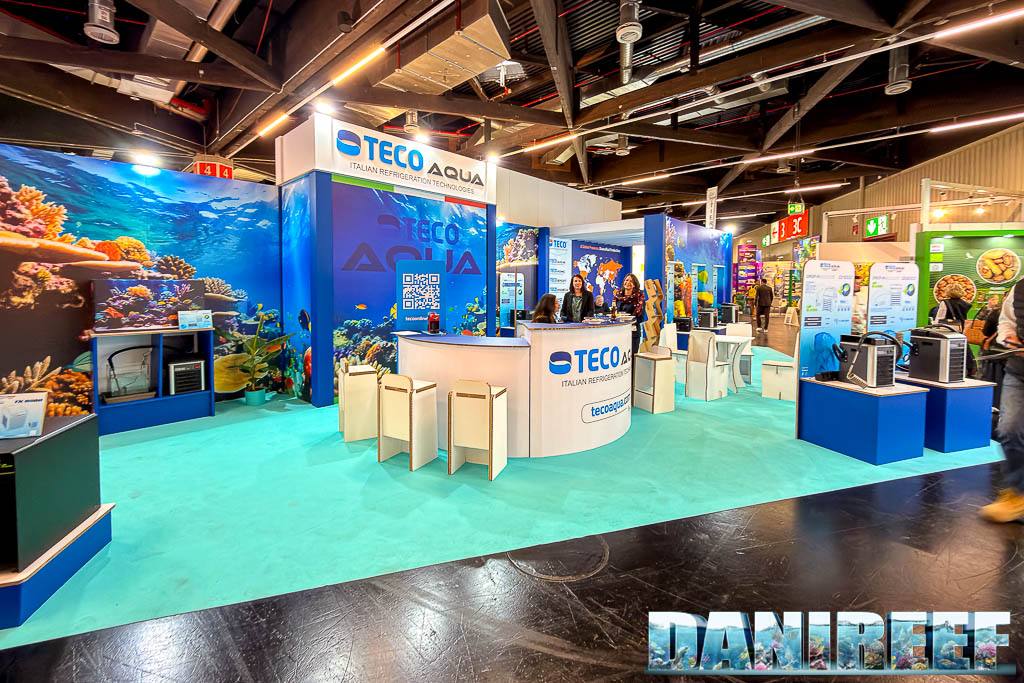
At Interzoo 2026, one of the most interesting technical innovations seen in the aquarium sector came from Teco, the historic Italian company known for its aquarium chillers. Not a simple aesthetic evolution, not a marginal update, but a rather important change of approach: separating the refrigeration unit from the titanium heat exchanger, bringing the latter directly into the sump or tank.

In a trade fair that, as we described in our general editorial on Interzoo 2026, seemed to us less spectacular than some previous editions, the solution proposed by Teco is one of those worth exploring in depth. Because it does not simply try to add one more feature, but attempts to rethink the way a chiller can be integrated into a marine aquarium, a freshwater aquarium, a sump or a technical tank.
Teco at Interzoo 2026 in short: the big news is the Drop-In line, with a separate refrigeration unit and a titanium heat exchanger to be placed directly in the sump or technical tank. The models presented are DI 500, DI 1000 and DI 2000, all using R290 gas, plug & play installation, no hydraulic connections required and a coil that must always remain completely submerged with adequate water flow.
The video of Teco at Interzoo 2026
For this article we prepared a dedicated video from the Teco booth at Interzoo 2026. In just over three minutes we take you directly in front of the new Drop-In chillers, with an overview of the technical solution and the concept of the titanium heat exchanger immersed directly in the water.
The video was created specifically as a support for this in-depth article: it is short, direct and helps to better understand the logic of the system, especially because in this case the novelty is not only in the product itself, but in the way it is installed and used.
Teco Drop-In: the chiller changes approach
The proposal shown by Teco at Interzoo 2026 is interesting because it touches one of the most practical, and often most annoying, aspects of managing a chiller: the passage of water through the cooling unit.
In the traditional system, the chiller is connected to the aquarium through hoses and requires a pump to circulate water inside it. It is an effective, well-known and proven solution, but it still involves a certain level of complexity: you need to choose the right pump, manage the hoses, find the space, avoid restrictions, control the flow and live with a system that is often not very easy to integrate under or near the aquarium.
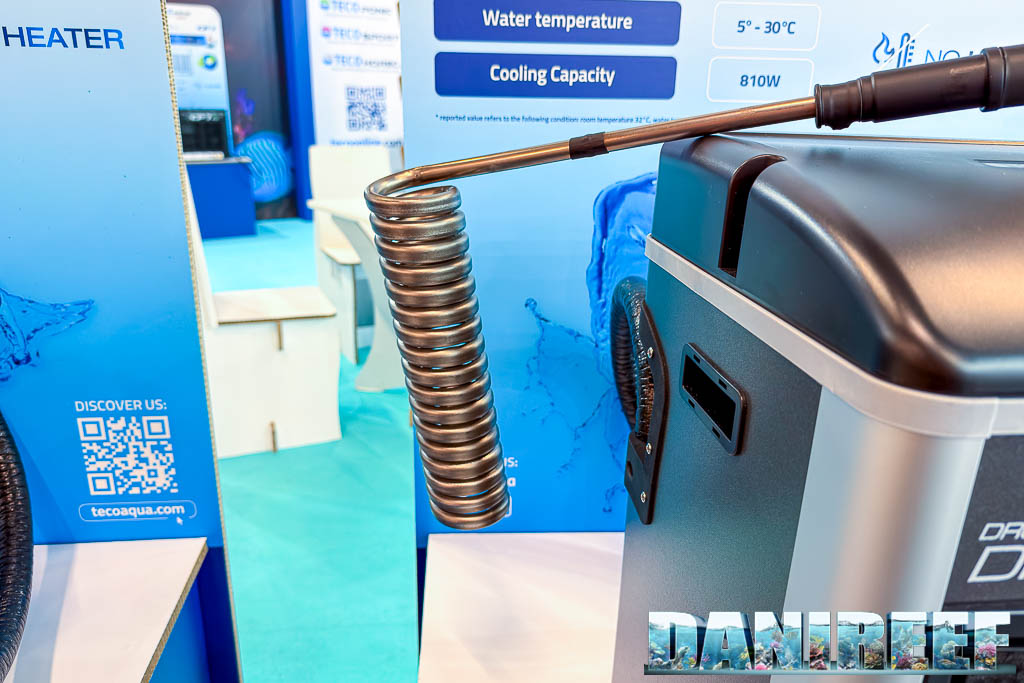
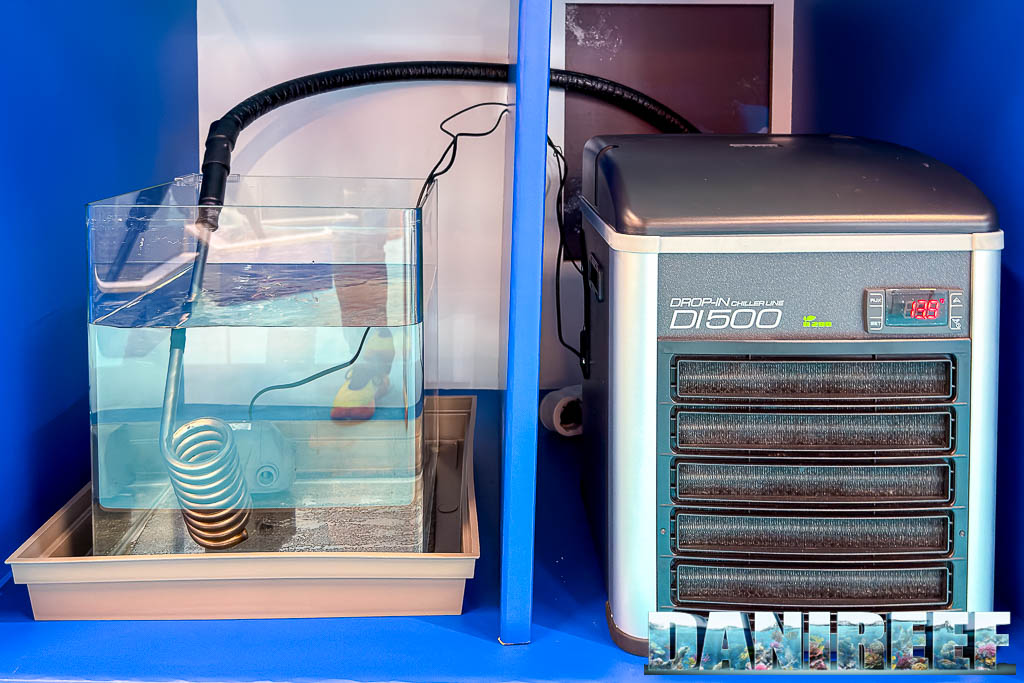
With the new Drop-In line, instead, Teco proposes a different approach: the refrigeration unit remains external, but the titanium heat exchanger is brought directly into the water, in the sump or technical tank. In this way, it is no longer necessary to make the water pass through the chiller: it is the chiller, through the immersed coil, that works directly on the water of the system.
The titanium heat exchanger directly in the sump
The heart of the system is therefore the titanium heat exchanger. Titanium has always been one of the most suitable materials for this type of aquarium application, especially in marine environments, because it offers good corrosion resistance and is compatible with salt water. In this case, it becomes the element that is immersed directly in the aquarium water.
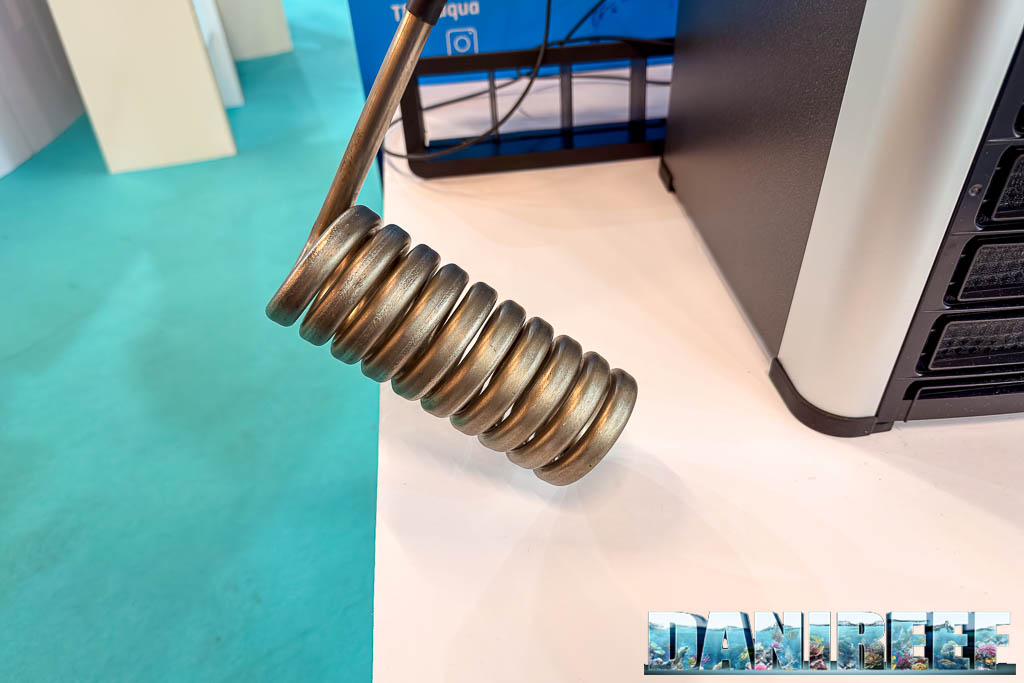
According to Teco’s technical documentation, the Drop-In chillers use a titanium coil immersed directly in the water, with quick installation and no modification to the system. There is, however, one fundamental point to underline: the coil must always be completely submerged and must be placed in an area with adequate water flow. This is an important technical detail, because heat exchange performance also depends on how the water moves around the exchanger.
From a practical point of view, the most interesting aspect is that heat exchange takes place where there is already moving water. In a well-designed sump, for example, the exchanger can be positioned in an area crossed by good flow, without having to add a specific pump only to feed the chiller.
The separate temperature probe: a major advantage
A further advantage of the new Drop-In line is the presence of a separate temperature probe. This allows the probe to be placed in the aquarium, or in any case in an area of the sump with strong circulation, preventing the reading from being too directly influenced by the thermal variations generated by the exchanger.
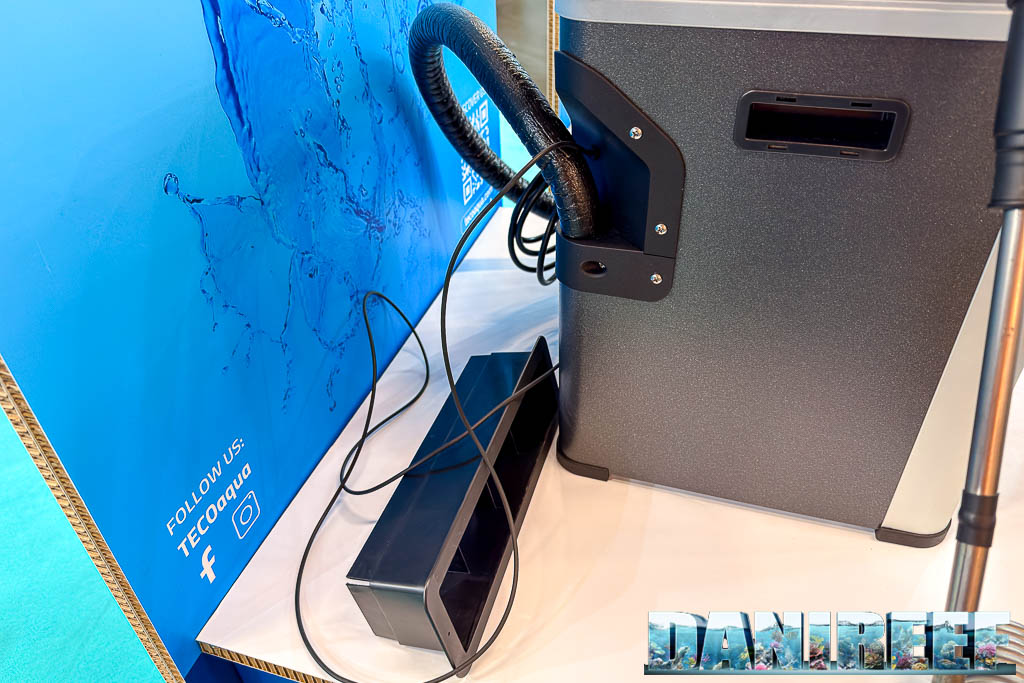
It is an apparently simple detail, but a very important one: measuring the temperature in the right place means having more realistic control of the entire system, especially in aquariums with complex sumps, areas with different flow rates or significant water volumes.
Plug & play installation, without hydraulic connections
The most obvious feature of the Drop-In series is simplified installation. Teco describes it as a plug & play system: the coil is placed in the sump or technical tank, the electrical power is connected and the system is ready to use. No hydraulic connections are required, there is no need to insert the chiller into the water circuit, and no dedicated pump is needed to push water inside the unit.
This means fewer components, fewer hoses, fewer possible leak points, lower electrical consumption linked to an additional pump and a potentially tidier installation. Of course, correct positioning of the exchanger remains essential: it is not enough to simply immerse it in any corner of the sump, but it is necessary to ensure that water can circulate properly around the coil.
The recommended applications are already running aquariums, DIY systems, temporary setups and emergency installations. And this is exactly where the concept becomes very interesting: the possibility of adding a chiller without modifying the hydraulic system can be a huge advantage in tanks that are already operating or in situations where you do not want, or cannot, intervene heavily on the technical setup.
The Teco DI 500, DI 1000 and DI 2000 models
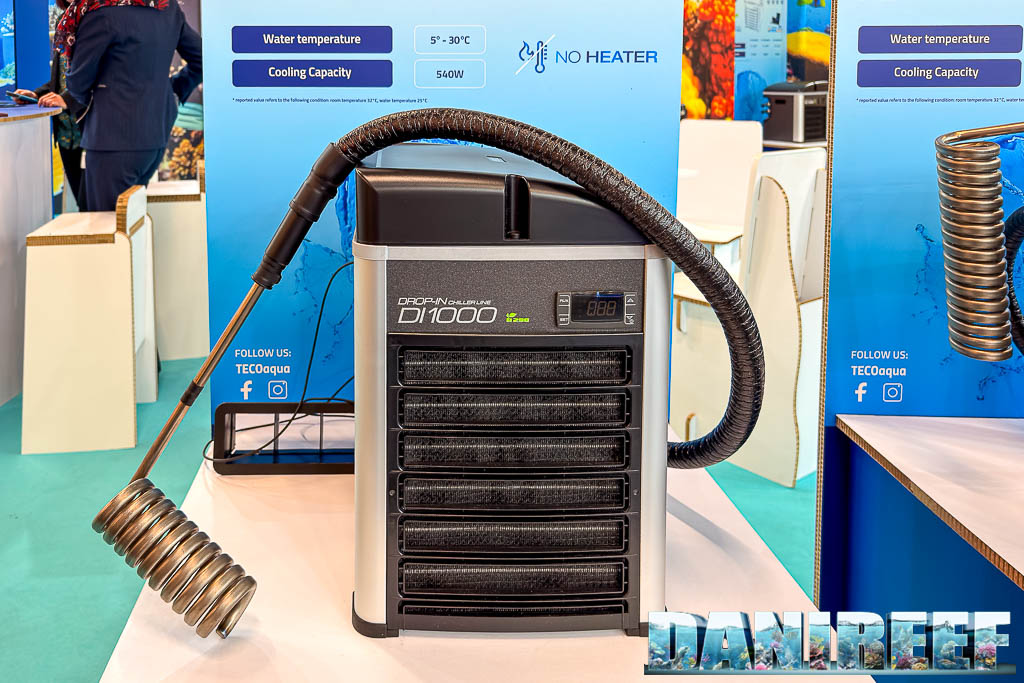
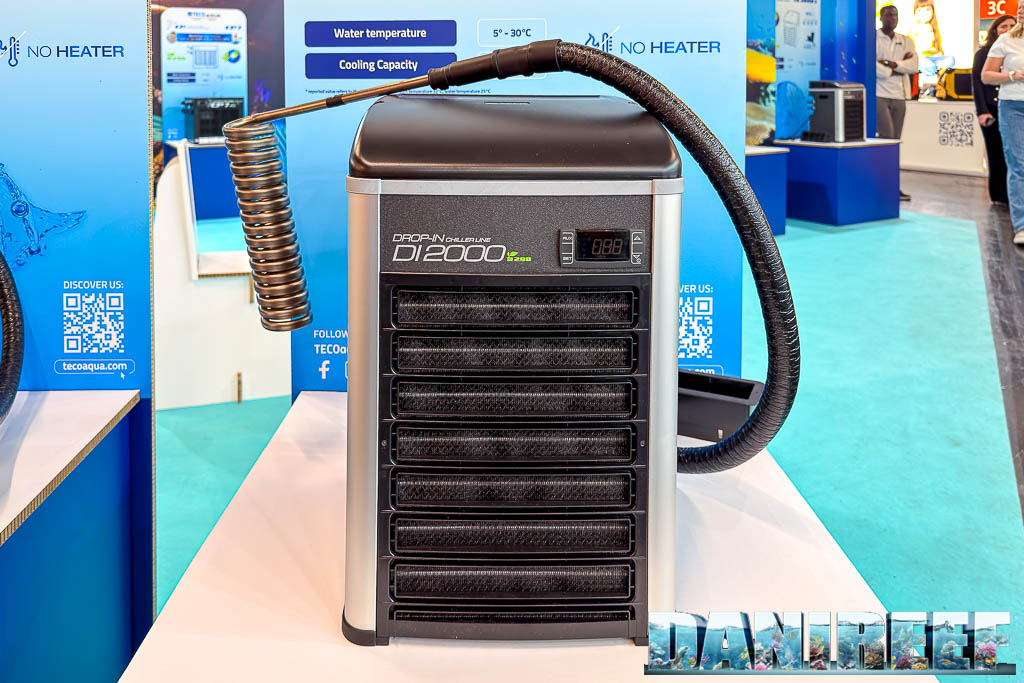
At the Teco booth we saw three models of the Drop-In line: DI 500, DI 1000 and DI 2000. The logic is to offer the same technical philosophy in different sizes, so as to adapt to aquariums with different volumes and cooling requirements.
The data declared by Teco are interesting. With an ambient temperature of 30°C and a thermal load of 0.2 W/l, therefore with water to be maintained at 25°C, the DI 500 is indicated for around 500 liters, the DI 1000 for around 1,000 liters and the DI 2000 for around 2,000 liters. In more demanding conditions, with water at 8°C and a thermal load of 0.1 W/l, the indicated volumes drop respectively to around 100, 150 and 280 liters.
This point is important because it reminds us of something that is often underestimated: when choosing a chiller, you should not look only at the theoretical volume, but also at ambient temperature, the thermal load of the aquarium, the amount of heat produced by pumps and lighting, the real volume of the system, the presence or absence of a sump, cabinet ventilation and the temperature delta you want to obtain.
| Model | Indicative volume at 25°C | Indicative volume at 8°C | Power consumption | Gas | Weight |
|---|---|---|---|---|---|
| DI 500 | 500 liters | 100 liters | 190 W | R290 | 15.7 kg |
| DI 1000 | 1,000 liters | 150 liters | 235 W | R290 | 18.9 kg |
| DI 2000 | 2,000 liters | 280 liters | 360 W | R290 | 20.3 kg |
The data on COP, the coefficient of performance, is also interesting: Teco declares values of 2.39 for the DI 500, 2.3 for the DI 1000 and 2.25 for the DI 2000 under the 25°C conditions. Under the 8°C conditions, the values drop respectively to 1.35, 1.68 and 1.52. These are not numbers to be read in isolation, but they help us understand that the performance of a chiller changes greatly depending on operating conditions.
R290, efficiency and attention to consumption
Another technical detail not to be underestimated is the use of R290 gas on all three models. It is an increasingly common choice in modern refrigeration systems, because it moves in the direction of greater attention to efficiency and environmental impact. Teco specifically emphasizes attention to environmental issues and energy savings as part of the design of its products.
The declared power consumption values are 190 W for the DI 500, 235 W for the DI 1000 and 360 W for the DI 2000. Here too, as always, the data must be interpreted in the real context: a chiller does not necessarily work continuously, but starts when it needs to bring the temperature back to the set value. With the same system, correct sizing can make a big difference both in terms of stability and overall efficiency.
Compact dimensions and robust structure
In terms of dimensions, the three models share the same footprint: 310 x 310 mm. The height changes, from 416 mm for the DI 500 to 458 mm for the DI 1000, up to 500 mm for the DI 2000. These are interesting dimensions because they allow the refrigeration unit to be evaluated quite easily for placement near the aquarium or in the technical cabinet, provided that correct ventilation is always guaranteed.
The declared working ambient temperature is between 16°C and 38°C. This is also important data: a chiller must be able to dissipate heat into the environment, so the place where it is installed is never secondary. A closed cabinet, with poor ventilation or already warm by itself, can reduce the efficiency of the system and make it more difficult to maintain the desired temperature.
Drop-In or InLine: two different philosophies
At this point it is essential to compare the new Drop-In line with traditional InLine chillers, because this is not about establishing that one solution is always better than the other. Rather, it is about understanding which approach is more suitable for your own system.
The InLine chiller, like the classic Teco TK 1000 that we had already seen and described on DaniReef, is connected to the aquarium’s hydraulic circuit. Water enters the chiller, passes through the internal exchanger and then returns to the tank or sump. It is a precise, proven and very tidy solution, especially when the system is designed from the beginning with the chiller included in the circuit.
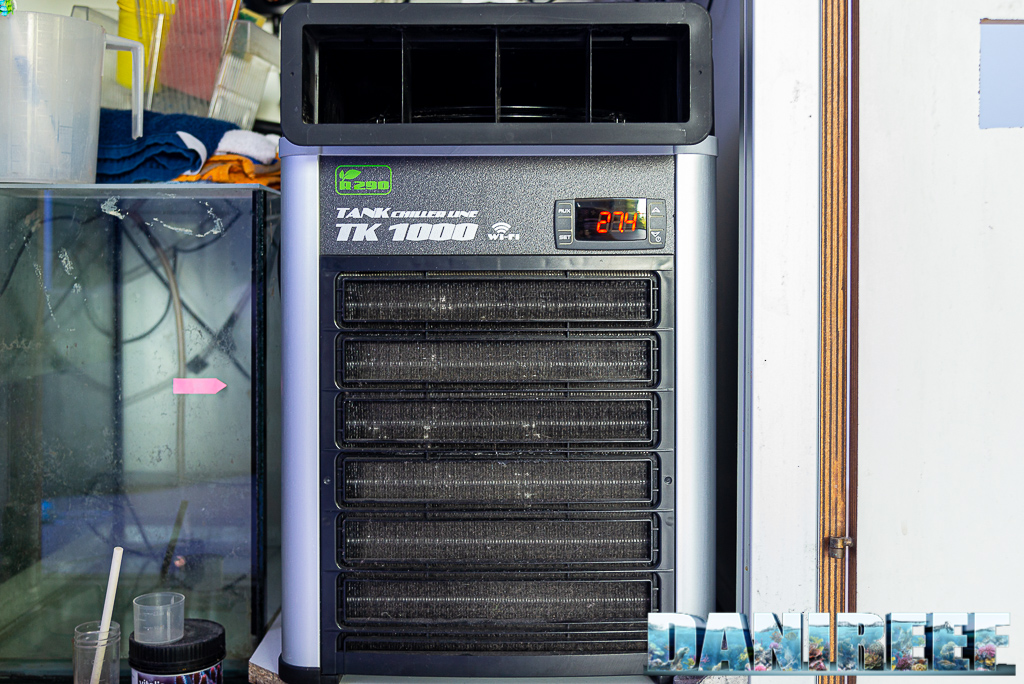
The advantage of the InLine approach is clear in well-designed systems: the chiller can be integrated into the water path and, if necessary, even positioned away from the aquarium. This also guarantees maximum aesthetic cleanliness.
The Drop-In, on the other hand, focuses on maximum flexibility: no hydraulic connection, immediate installation, lower risk of hose-related leaks and broader compatibility with existing systems. But it must be installed next to the aquarium or sump, potentially creating some greater aesthetic dilemmas.
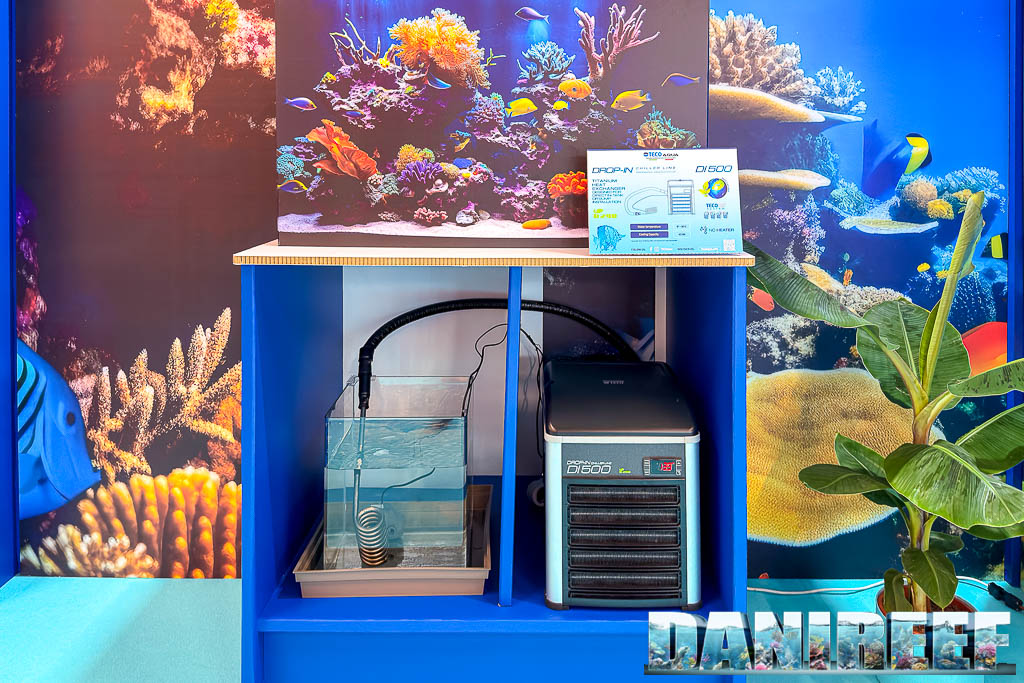
For this reason, in our opinion, the Drop-In line can be particularly interesting in three cases: already running aquariums where you do not want to modify the system, technical tanks or professional systems where functionality is the main priority, and temporary or emergency situations where water needs to be cooled without having to redo all the plumbing.
The advantages for those who have a sump
In our opinion, the most natural context for this solution is an aquarium with a sump. In a properly sized sump it is easier to find a space where the titanium exchanger can be placed, kept correctly submerged and guaranteed a good passage of water around the cooling element.
In this scenario, the advantage over a traditional chiller can be clear: no dedicated pump, fewer hoses to manage, a cleaner installation and lower overall complexity. Of course, the size of the exchanger, its position in the sump and any possible interaction with other technical components will need to be carefully evaluated, but the idea makes a lot of sense.
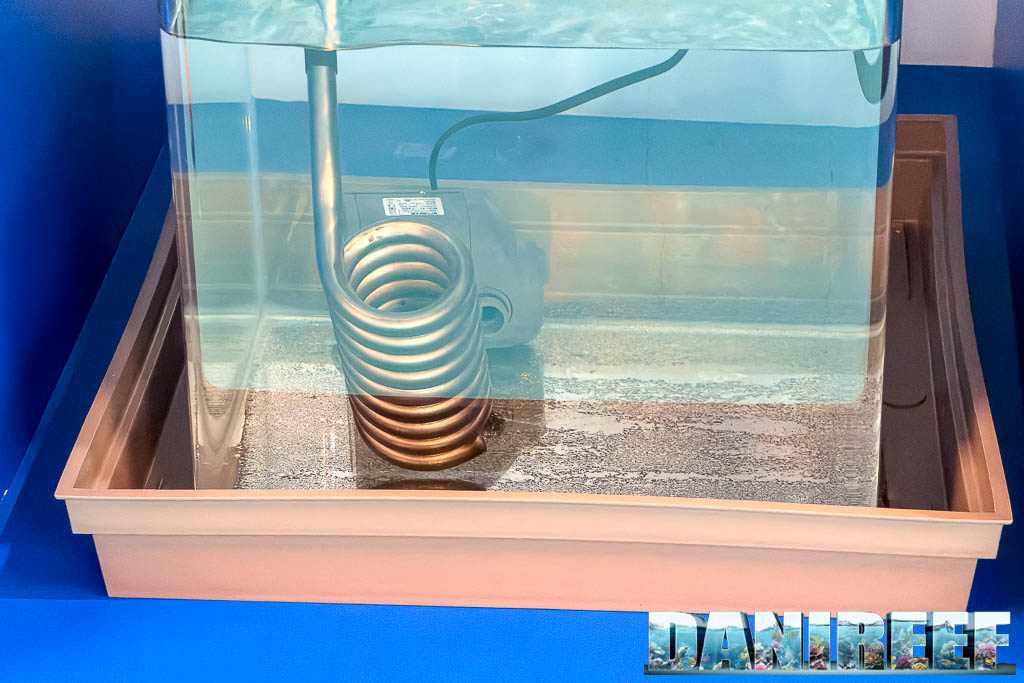
For aquariums without a sump, the situation changes. The exchanger can theoretically be placed directly in the tank, but here aesthetic and practical considerations also come into play. Not everyone will want to see a technical element immersed in the main aquarium, especially in tanks that are very carefully designed from an aesthetic point of view. In breeding systems, technical tanks or aquariums where functionality matters more than appearance, however, it could still be an interesting solution.
A solution that will spark discussion
The proposal from Teco will probably spark discussion. On one side there will be those who immediately appreciate the simplicity of the concept: fewer hoses, fewer pumps, direct exchange in water. On the other side there may be those who have some doubts about the size of the exchanger, the aesthetics, cleaning over time or the best position in the sump.
And it is normal for this to be the case. Whenever a product changes an established habit, the market’s first reaction is often divided. But that is precisely why this novelty is interesting. Because it does not simply propose the classic chiller again with a few updated details, but opens a different path.
Long-term management also remains to be evaluated. A coil immersed in marine water will need to be kept clean, free from deposits and positioned so that it does not become a dead spot in the sump. But these are normal management aspects for any technical component immersed in the aquarium, and they do not reduce the interest of the solution. Moreover, we believe that cleaning the coil externally is much simpler than cleaning the hydraulic circuit internally.
Teco and the Italian cooling industry in aquarium keeping
Another aspect we like to underline is the role of Teco as an Italian company in a very technical sector. Chillers are less “emotional” products than a light, a set-up aquarium or a scenic skimmer, but they are fundamental for the stability of many systems, especially in summer and especially when keeping animals that are sensitive to temperature fluctuations.
In marine aquarium keeping, temperature is not a detail. A system that remains stable is a system that places less stress on corals, fish and invertebrates. For this reason, when a chiller is needed, it should not be seen as a secondary accessory, but as an important part of the aquarium’s technical management.
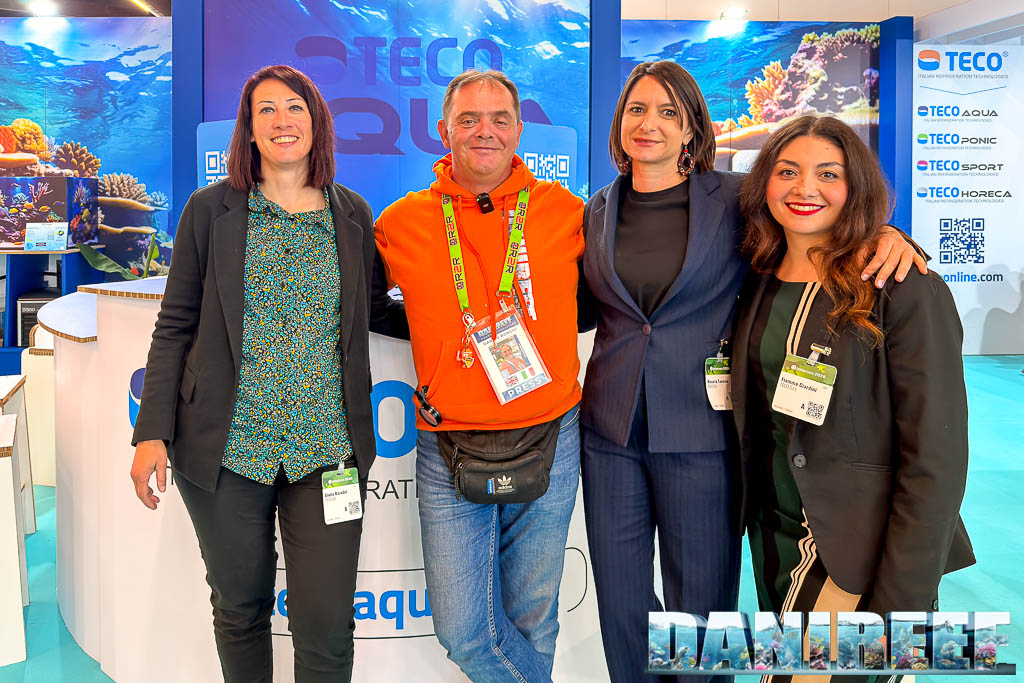
Seeing an Italian company like Teco continuing to invest in this sector, while also trying to propose solutions different from traditional ones, is certainly positive. It means that there is still room for innovation even in product categories that already seem mature.
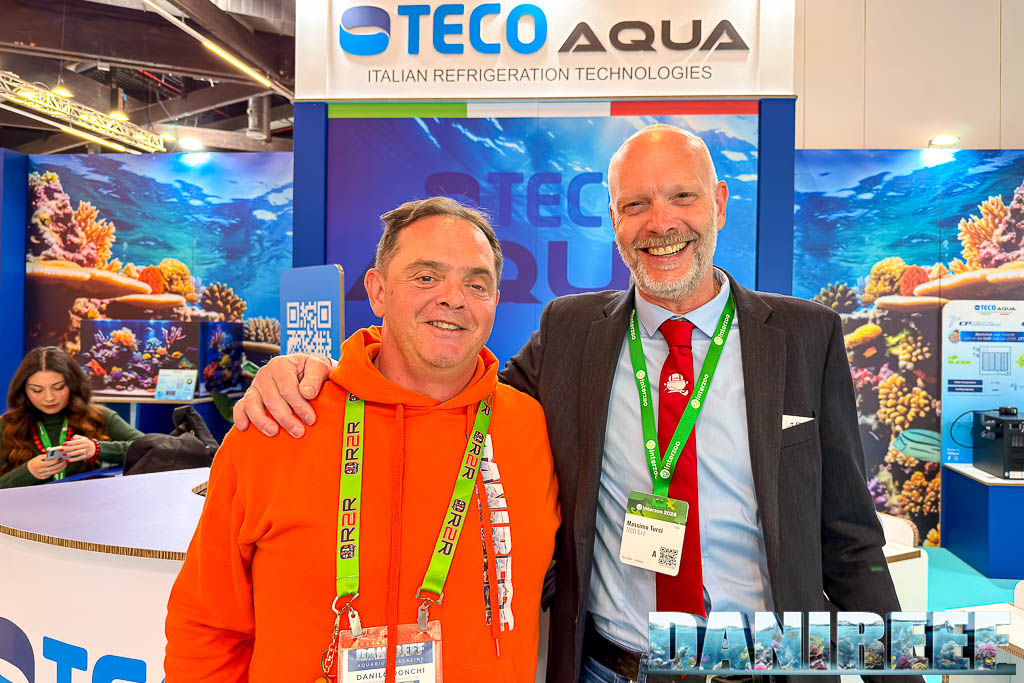
We thank Massimo Turci and the entire Teco team for welcoming us at the booth, for the time they dedicated to us and for their willingness to answer our technical questions.
Teco will be at AcquariaItalia 2026
For those who want to see the new Drop-In line up close and speak directly with the company, Teco will also be present at AcquariaItalia 2026, the Italian aquarium fair that will be held at Malpensa Fiere. The company is expected to be present both during the days open to the public and during the day dedicated to B2B, designed for retailers, distributors, companies and industry professionals.
This is an important point, because technical products such as chillers are much easier to understand when they can be seen live, compared with the real needs of aquariums and discussed directly with those who design and distribute them.
The complete reportage from Interzoo 2026
This article is dedicated to Teco, but it is part of our broader special coverage of Interzoo 2026. In the complete video reportage you will also find the other aquarium booths we visited in Nuremberg, with Italian and international companies, products, display aquariums and our general considerations about the fair.
If you also want to read our general analysis of the fair, with numbers, impressions, attending companies, the most beautiful aquariums and considerations on the state of the sector, we refer you to our main article: Interzoo 2026: the DaniReef video reportage from Nuremberg. In that article we will also progressively collect all the in-depth reports already published and those we will publish in the coming days.
What we think
The innovation brought by Teco to Interzoo 2026 seemed to us one of the most interesting at the fair from a technical point of view. Not because it is necessarily the perfect solution for everyone, but because it addresses a real problem: making the chiller easier to integrate into the aquarium, especially in systems with a sump.
The idea of the immersed titanium heat exchanger is logical, concrete and potentially very effective. It eliminates the need for a dedicated pump, reduces the amount of piping and brings heat exchange directly where it is needed: into the water of the system. Of course, its real-world performance, footprint, maintenance and long-term behavior will need to be evaluated, but the direction seems very interesting to us.
In the end, this is probably the most important thing: Teco did not simply present a new chiller, but tried to change the way we think about aquarium cooling. And in a fair where many companies chose consolidation, seeing such a precise and different technical proposal really pleased us.
For more information on the Drop-In line and the other Teco chillers, we also refer you to the official Teco website.
DaniReef special coverage of Interzoo 2026
This article is part of our special coverage dedicated to Interzoo 2026. In the main article you will find the complete video reportage from Nuremberg, our general analysis of the fair and the updated list of all the in-depth articles already published and in preparation.
And what do you think? Do you prefer the classic chiller with pump and hoses, or are you convinced by the idea of a titanium heat exchanger to be placed directly in the sump or technical tank? Let us know in the comments below, or on our social channels Telegram, Instagram, Facebook, Twitter and YouTube. And if you need help, we are waiting for you in our forum too.
Scopri di più da DaniReef - Portale dedicato a Acquario Marino e Dolce
Abbonati per ricevere gli ultimi articoli inviati alla tua e-mail.