
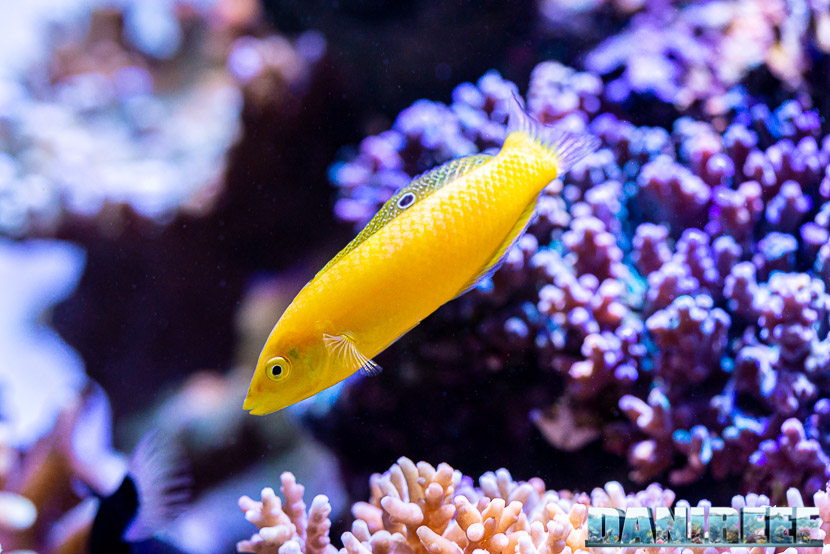
Halichoeres chrysus is one of the most beloved fish among marine aquarists: colorful, tireless, and extremely useful for managing a reef aquarium. It does not have the “troublemaker” reputation of other wrasses and is instead considered one of the best fish to keep coral-eating nudibranchs, flatworms, and small parasites under control. But is it truly suitable for all aquariums? Let’s examine its strengths, limitations, and the best tips to keep it successfully.

Also known as the Yellow Wrasse, Golden Wrasse, or Canary Wrasse, Halichoeres chrysus belongs to the Labridae family. Scientifically described in 1981 by Randall, it is a very hardy, active, and relatively peaceful fish, extremely useful for controlling pests and unwanted invertebrates. Unlike many other wrasses, it is less prone to stress and adapts easily to aquarium life… but it still needs a mature tank of adequate size and, above all, a sandy substrate where it can bury itself.
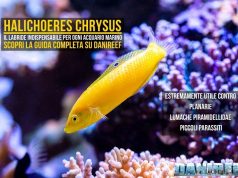
Halichoeres chrysus
Halichoeres chrysus is easily recognized by its bright yellow coloration, with one or more black spots on the dorsal fin (which increase with age). Adults may develop orange shades and faint blue lines near the snout. The genus includes over 50 wrasse species distributed across the Indo-Pacific, many of them specialized in hunting small crustaceans and worms.

This fish is incredibly active: it spends all day searching through the rockwork for small invertebrates and is always aware of what is happening in the tank. It is generally peaceful toward other fish, although it may show some competitiveness toward other wrasses. With the right tank mates, however, it coexists well with most fish commonly kept in reef aquariums.
Like all members of the Halichoeres genus, it is an excellent predator of coral-eating nudibranchs, flatworms, small crustaceans, and pests that infest corals such as Zoanthus, Acropora, and Montipora. This makes it one of the best “biological helpers” you can introduce into a mature reef system.
How effective is Halichoeres chrysus against parasites?
The reputation is deserved: Halichoeres chrysus is one of the most effective fish against many common pests. In most aquariums, it quickly begins hunting flatworms, Montipora-eating nudibranchs, small crustaceans, planaria, and hidden parasites among the corals. It is not a magical, guaranteed solution, but it is often one of the best natural tools available to aquarists. And from what I’ve observed, it is easier to manage than its cousin Pseudocheilinus hexataenia — not because it is more effective, but because it is far more peaceful toward other fish.
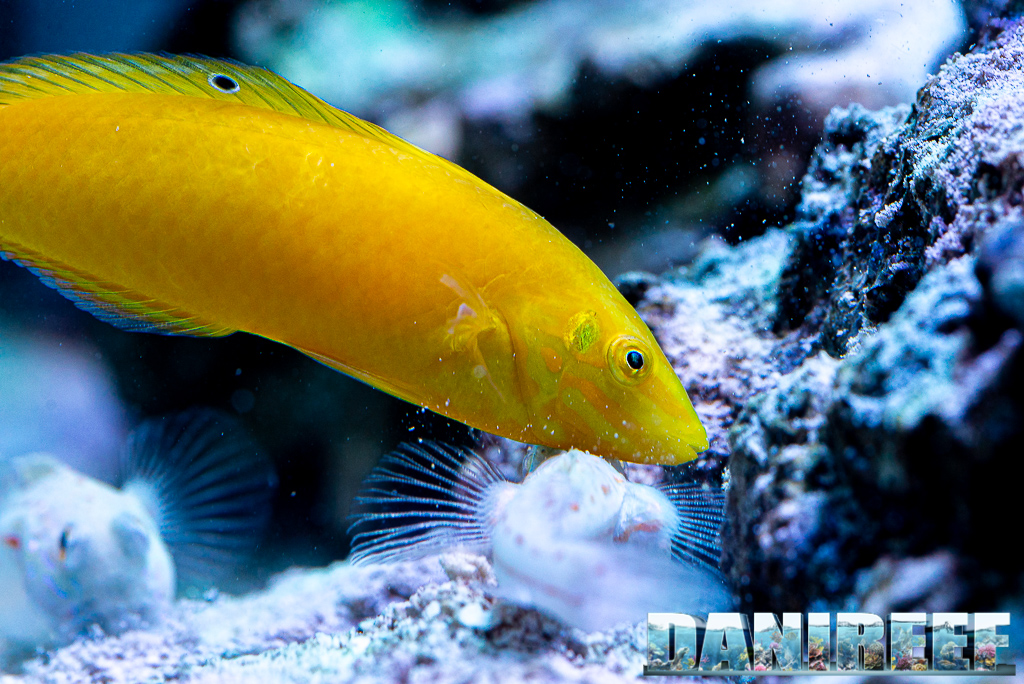
Halichoeres chrysus is excellent against planaria and also against pyramidellid snails that infest Tridacna clams. A constantly active fish that should not be missing in a mature reef aquarium. Beautiful and useful — what more could you ask for?
Does it eat corals?
No: Halichoeres chrysus is not a corallivore. It is considered reef-safe “with some reservations” because it may occasionally eat:
- tube worms
- substrate microfauna
- small crustaceans
- feathers of feather duster worms and similar organisms
But it does not pose a threat to LPS, SPS, or soft corals. It is far safer and easier to manage than butterflyfish or many dwarf angels.
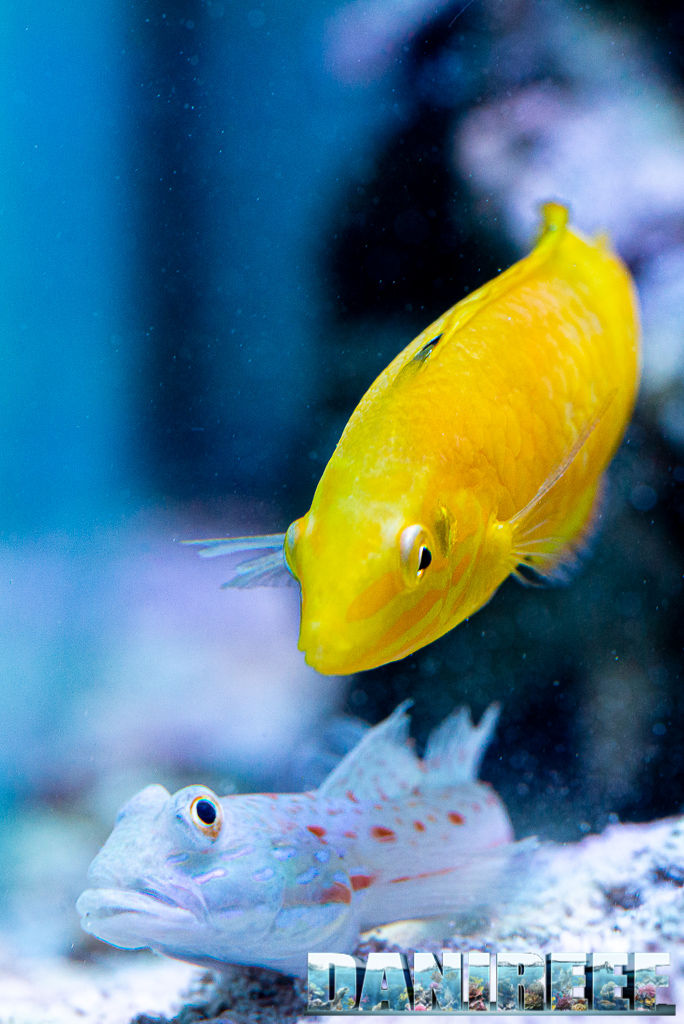
The only real caution concerns very small or newly introduced shrimp, which may be preyed upon if too small or not fully acclimated.
Distribution
Halichoeres chrysus is widely distributed throughout the tropical Indo-Pacific: from southern Japan to the Philippines, Indonesia, New Guinea, Fiji, and Australia. It lives between 5 and 30 meters, especially in areas rich in sand and rock, essential for its natural behavior.

Behaviour and recommended aquarium size
As an adult, Halichoeres chrysus reaches about 12 cm. To keep it properly, I recommend at least 150 litres with a soft sandy bottom (essential!) where it can bury itself at night or when frightened. Without fine sand, the fish experiences significant stress.
This fish is active but not aggressive, compatible with tangs, anthias, peaceful butterflyfish, gobies, dwarf angels and many more. It should not be kept with highly aggressive wrasses such as Thalassoma, some Coris, very territorial Pseudochromis, or predatory species.
How to maximize your success
Halichoeres chrysus is hardy but requires essential conditions:
- a tank matured for at least 6 months
- fine sand, 3–5 cm deep
- a varied diet: mysis, artemia, high-quality granules, occasional vegetable matter
- no overly aggressive feeding competitors
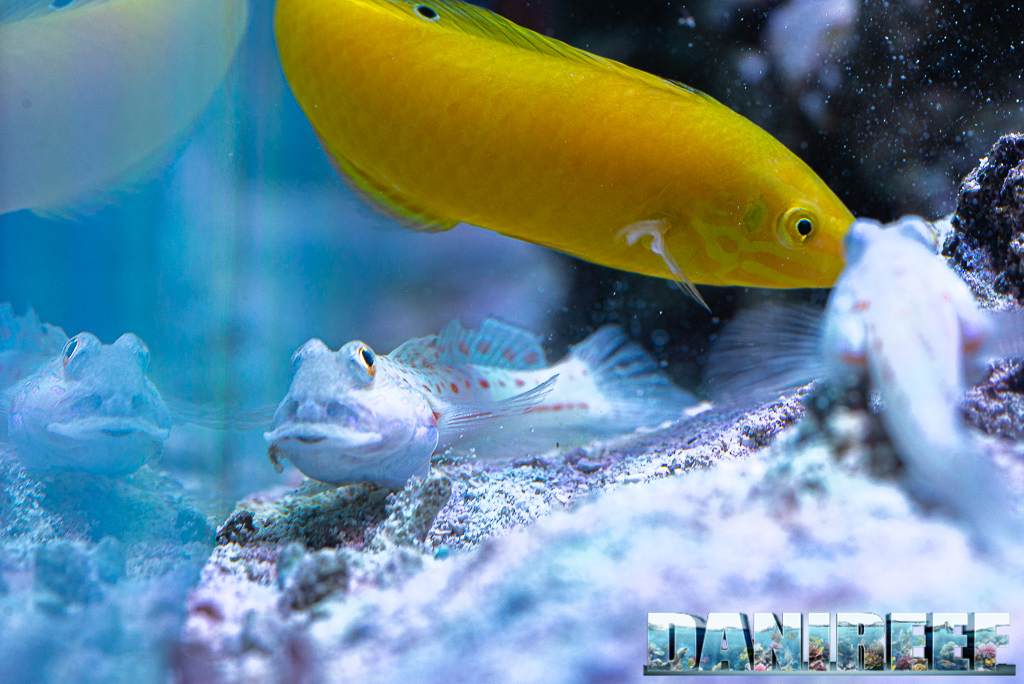
Young individuals adapt more easily and quickly become part of the reef’s balance. In large tanks — over 500 litres — they can even be kept in small groups. Be aware that this species loves to jump out of open tanks, so a mesh lid is highly recommended.
What we know about the reproduction of Halichoeres chrysus
Halichoeres chrysus is a protogynous hermaphrodite: individuals are born female and, if conditions allow, some transform into dominant males. In nature, they often live in small groups, with one male breeding with several females. Spawning is oviparous, with eggs released into the water column — a pelagic strategy common among wrasses.
Did you know?
Halichoeres chrysus often changes behaviour and diet with age: juveniles are more predatory and active, while adults become slightly more territorial and display orange hues. It is one of the few wrasses considered relatively safe in SPS-dominated reefs, and is famous for its amusing habit of “diving” into the sand at the slightest noise.
The DaniReef recommendation: HIGHLY RECOMMENDED in mature aquariums with a sandy bottom. A fantastic ally against pests, peaceful and spectacular to watch. Special trait: always moving, always useful!
Have you ever kept a Halichoeres chrysus? Tell us about your experience in the comments! Follow us on Telegram, Instagram, Facebook, X, and YouTube. For technical questions, join our forum.

Scopri di più da DaniReef - Portale dedicato a Acquario Marino e Dolce
Abbonati per ricevere gli ultimi articoli inviati alla tua e-mail.