
How should we evaluate these numbers in an aquarium?
This is a good question, in the sense that at first we thought we could directly translate these numbers to an aquarium tout-court.

Then we filled a tank with water, immersed the probe, and repeated some measurements. That caught us off guard but, as we’ve already said in previous articles, we’ll talk about it in a future in-depth piece, which we will link here afterwards. In practice, while at 20 cm the result is practically identical, as you go deeper, thanks to the glass that reflects the light and the water itself that diffuses it more, you can find values even double compared to those measured in air. Obviously this is not a detail that can be standardized, so we believe our calculation methodology is the most correct, and the best for comparing the coverage of different fixtures.
Radion G5 Blue vs A8 Pro II Blue: who will win?
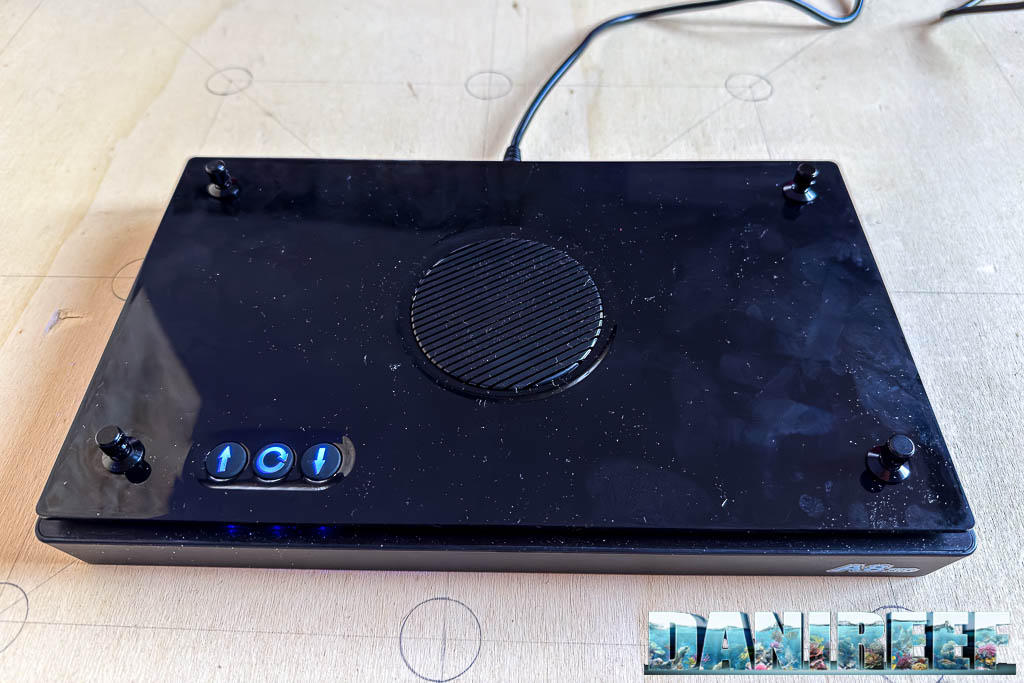
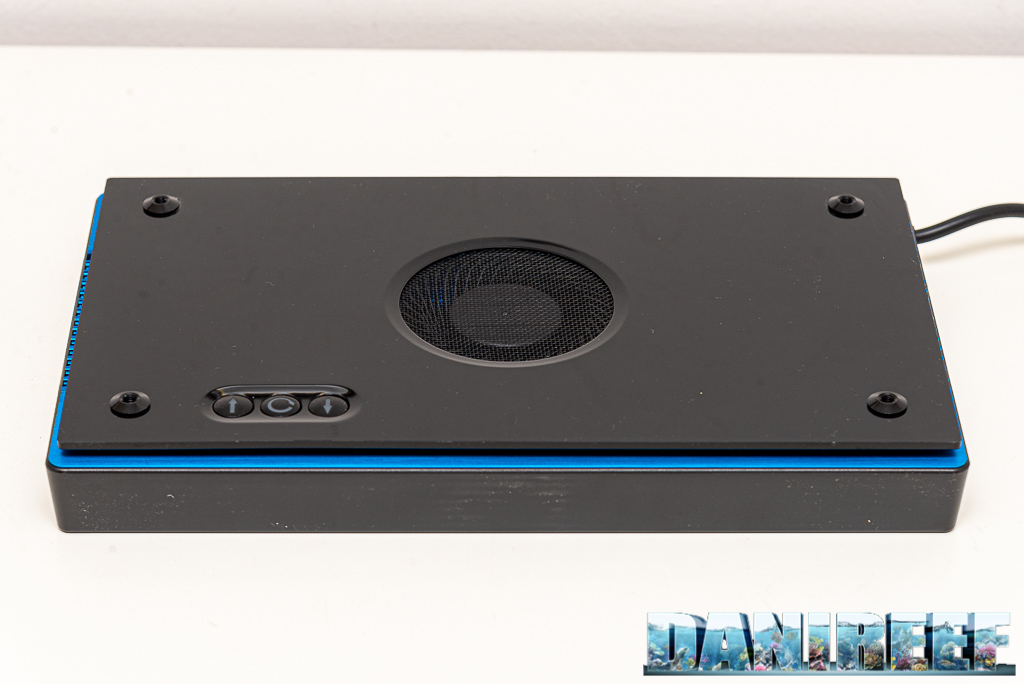
Given the similarity between the two fixtures, it seemed right to compare them. Unfortunately we have not (yet) had the G6 Blue in our hands, so we are comparing the 2024 A8 Pro II Blue with the 2020 Radion G5 Blue, whose review you can read here: Ecotech Marine Radion XR30 G5 Blue finalmente nel DaniReef LAB. So there are 4 years of development between the two fixtures. But let’s see the results together.
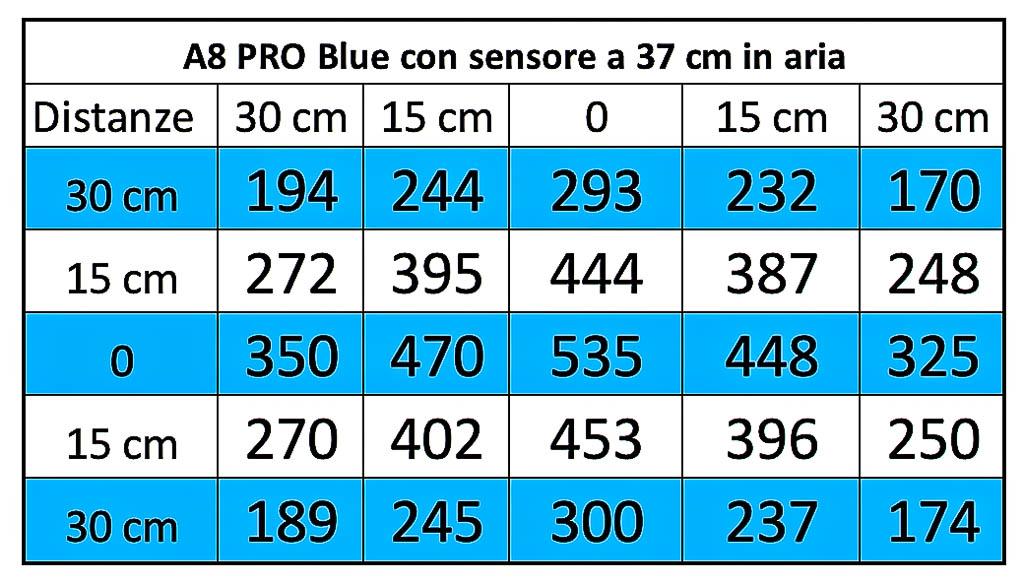
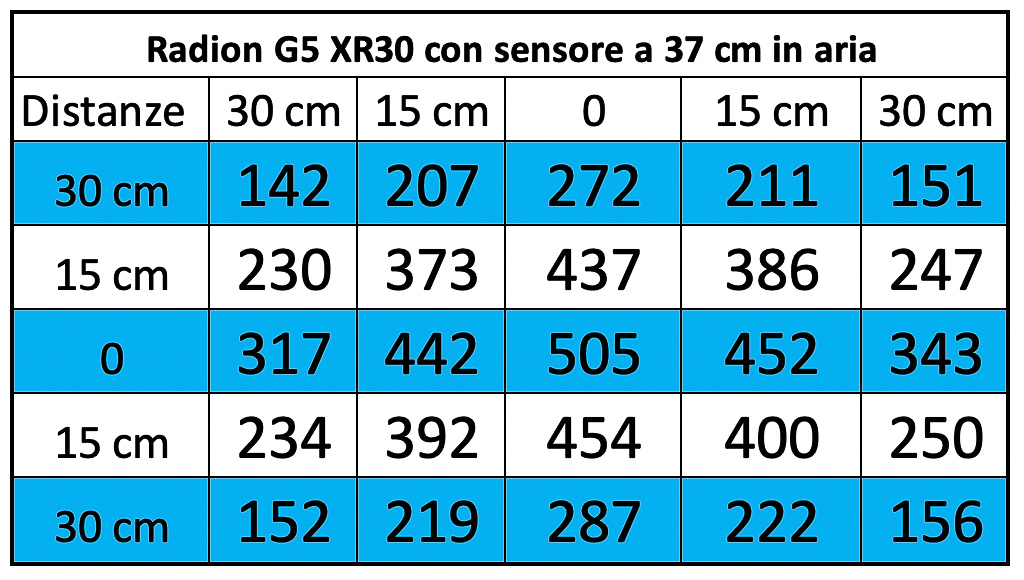
As you can see, at 37 cm distance the A8 delivers 6% more power.
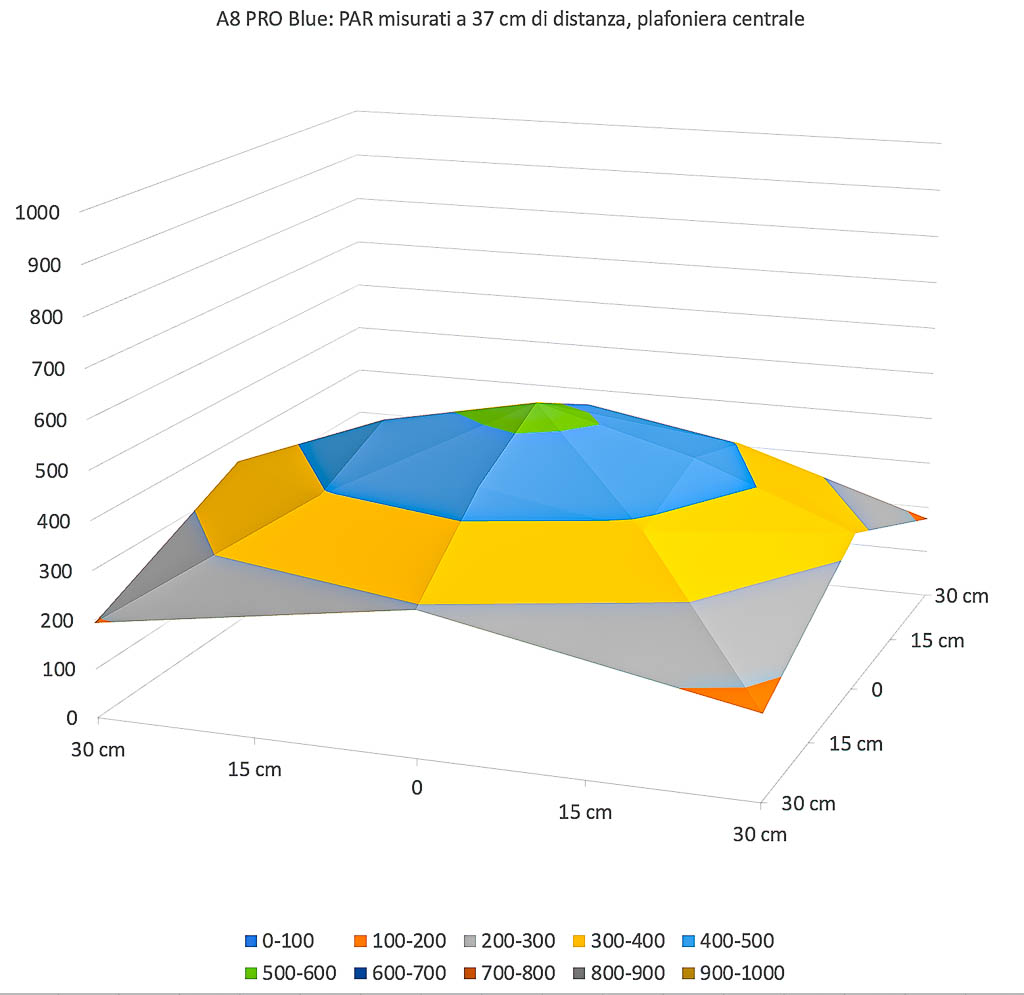
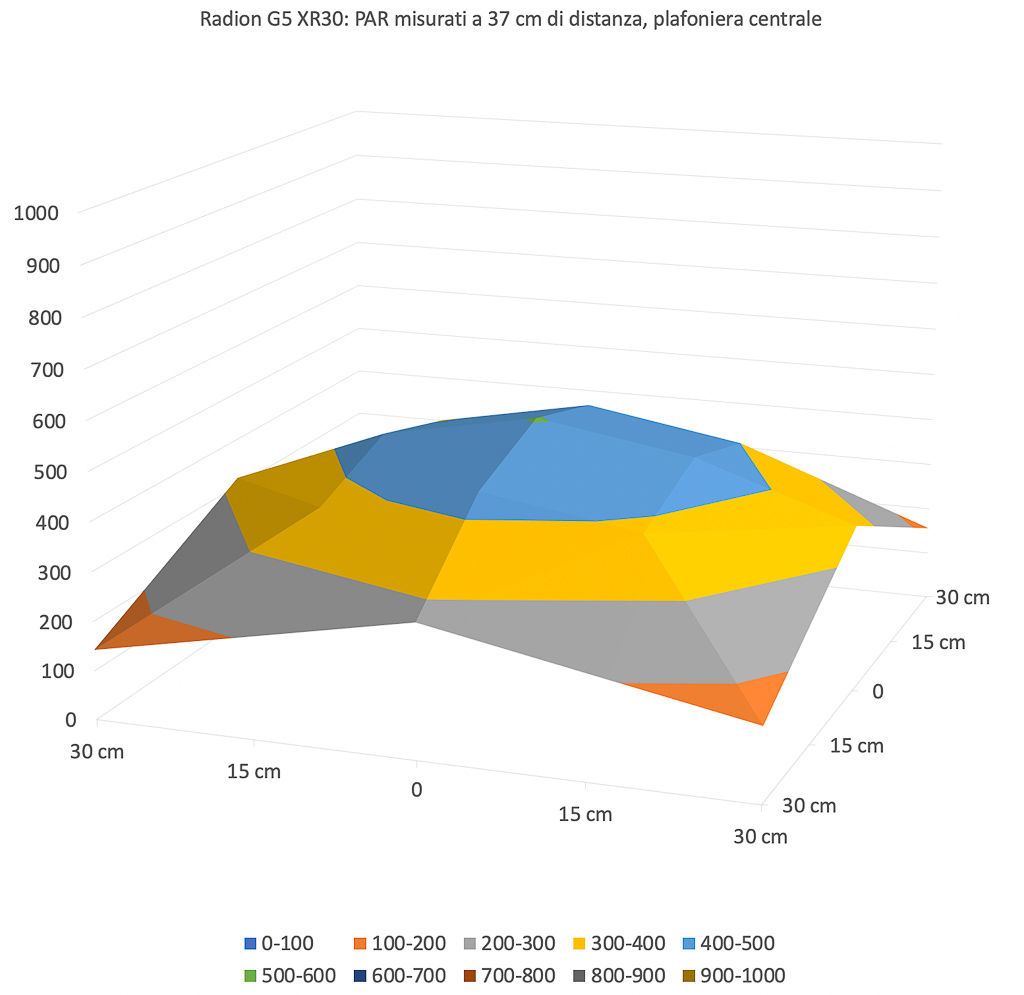
The coverage graph, again at 37 cm, also shows the A8 as slightly superior. But on paper, the difference is rather negligible.
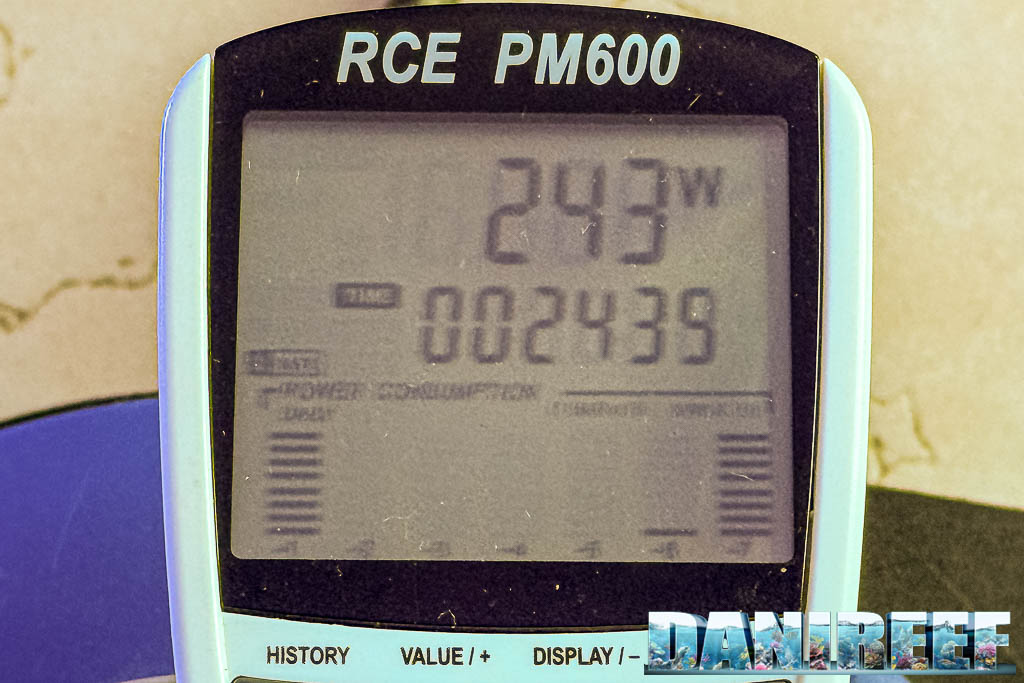
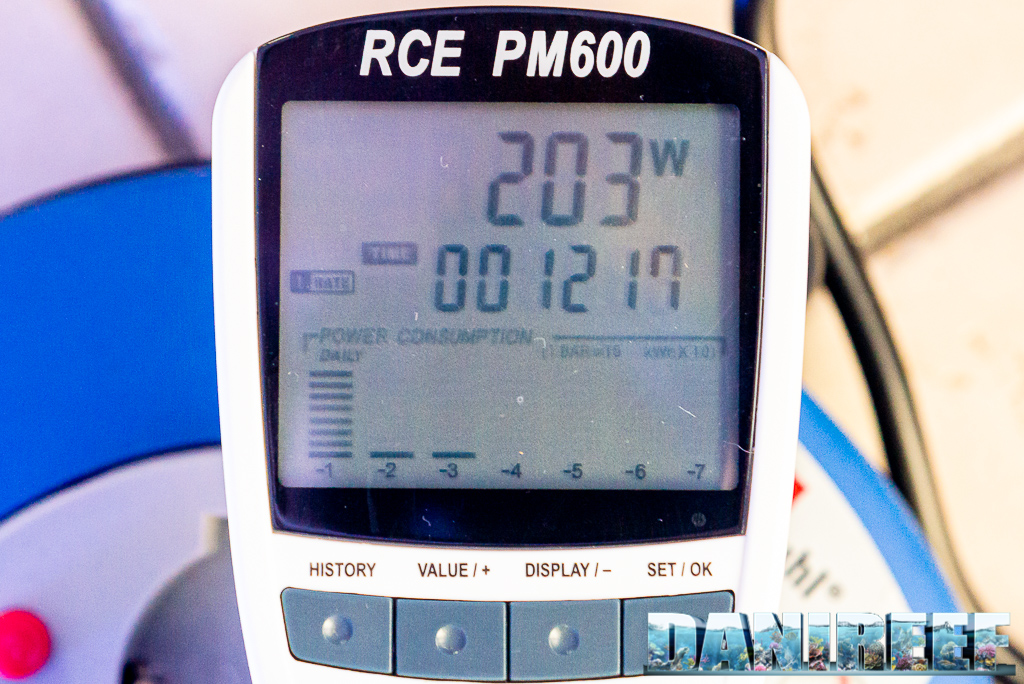
However, analyzing consumption we see there is an important power difference between the two fixtures. We do have, roughly, 6% more PAR, but at the cost of a 20% increase in consumption. In perspective this means that each year, roughly, you will consume about 130 kWh more, for an extra cost of 35 euros per year per lamp. But before drawing your conclusions, read what else we have to say.
For now we can say the two fixtures produce about the same PAR, but one consumes 20% more than the other, while costing about 40% (of the other’s price).
Defects found on the A8 Pro II Blue
As we told you at the beginning, we had 3 A8 fixtures in our hands. We did not test them all in the same way, but we measured PAR and central consumption on all three. We found that beyond the first one we measured at 243 watts, the second consumed 255 while the third only 196.50, as you can see in the photo we took.
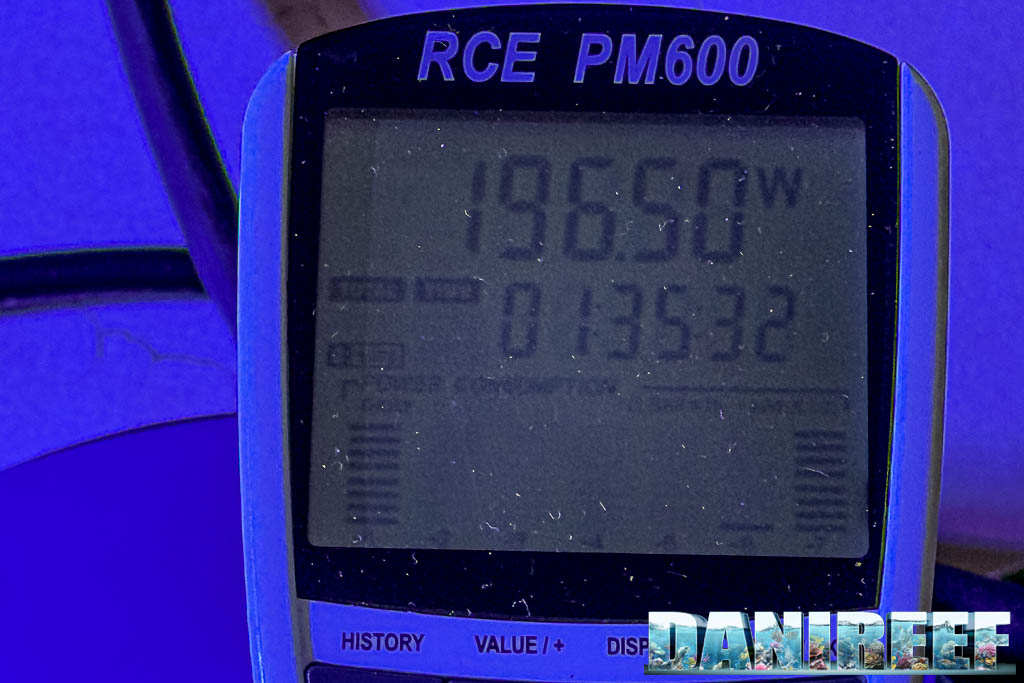
PAR obviously varied proportionally. But the problem from this point of view is another one. A fixture that consumes much more to deliver the same PAR is a fixture that develops more heat, with effects that could be harmful for the LEDs soldered on the board itself.
Furthermore, the difference between the three fixtures does not guarantee their homogeneity. It could absolutely be a coincidence, but who assures us that if we had ordered only one, we would have received the “normal” one? Absolutely commendable was the company’s behavior: once informed about the consumption discrepancy, they immediately sent Andres a replacement for the clearly defective unit.
Another flaw is the difficulty of programming we mentioned on page one. The app is slow and cumbersome.
But this is not the worst thing.
As of the day we write this, if the fixture is plugged in and the power goes out, it must be reconfigured manually. Something that, if not resolved, prevents us from recommending this fixture. A brief outage would be enough to leave our aquarium with the wrong lighting, for a random duration, and if this happens while you are on vacation it could be a serious problem.
Maintenance Costs
The A8 Pro II Blue fixtures currently cost €548.98 list, but on AliExpress they can also be found at €350 on sale, as for example by clicking here.
We saw that the power draw is 243 watts, so a cost/watt ratio of about €2.27 per watt when considering list price, otherwise it would be €1.44. One of the highest values we have ever recorded.
If we go back to the 243 watt consumption and consider 8 hours at maximum (in reality it will run longer, but with sunrise/sunset ramps), we can estimate yearly consumption at about 708 kWh, and a cost of €191 per year per fixture (considering the energy cost at €0.27 per kWh).
Final considerations on the A8 Pro II Blue
The fixture is built fairly well, and shows low efficiency but at a very low cost. The economic efficiency is therefore extremely high, but the technical efficiency, i.e., PAR produced per watt, is rather low — one of the worst.
Below is the spectral distribution (PFFD) at various depths measured in clear ocean waters. The values are as follows:
| 1 m | 5 m | 10 m | 15 m | 20 m | |
| PFFD (µmol/m²/s) | 1640 | 958 | 618 | 436 | 316 |

So at 37 cm distance with an A8 Pro II Blue set to maximum we obtain 535 µmol/m²/s with Apogee and 586 µmol/m²/s with PARWISE PRO. An approximate value in Nature corresponding to 11–12 meters below sea level. More than enough power! And it should allow you to keep practically any coral.
The values are very good for tanks aimed at keeping SPS as well as anything else. By pairing multiple fixtures you can then keep everything with any desired color temperature. I would recommend 2 fixtures on 120 cm and 3 on 180, and respectively 3 or 4 to get the most and push where other fixtures cannot go. Obviously, if we consider demanding SPS, the central band would be preferable given the physiological center–edge drop and the light angle. The power produced is very good especially at shallow depth, as is obvious. As depth increases, power decreases to achieve greater coverage, which always remains quite wide. The doubts, given the high consumption, are about long-term durability and the lack of homogeneity between identical fixtures. Remember though that this is not a Radion, the spectrum is different as are the channels.
PROS
 Very low price;Rather high PAR;
CONS
 20% higher consumption at equal PAR than a fixture 4 years older;Three fixtures with three different outputs, one of which much lower than the other two;Embarrassing software;Must be manually re-set when power returns after an outage.
If you have questions, doubts, or curiosities, remember you can leave a comment under the article, and you can also find us on Telegram, Instagram, Facebook, X and YouTube, whichever social you prefer to follow us on so you don’t miss our news, articles, reviews and reports; and if you need help, we’re waiting for you in our forum.
 This article has also been featured on reefs.com, one of the leading international reefkeeping portals.
Disclaimer: The A8 Pro II Blue fixture used for this test was provided by our friend Andres, who uses them on his aquarium. Some links in the article may include affiliate codes with sponsored partners.
Scopri di più da DaniReef - Portale dedicato a Acquario Marino e Dolce
Abbonati per ricevere gli ultimi articoli inviati alla tua e-mail.